Saturday, 24 November 2012

Intelligent Design

       The little Smart car that is my workhorse is fantastic in many respects - it is small enough for me to park in my overcrowded street where other cars can't fit into the space, it takes daily battle scars of people pulling in on the narrow hill, letting their foot of the foot break or plainly misjudging their car's clearance and banging into the wings of it and I have a box trailer for occasional heavy loads. And it is economic.
        I can live with the BMW drivers who insist on coming right up to my rear on the open road as I know I can easily blow them away on my motorcycle, but what I find is mind-numbing is a discovery that has temporarily left my intelligently designed little Smart car a piece of useless plastic metal and rubber parked on the road, awaiting a cost effective solution.


Compact, turbo charged 50+mpg Smart Fortwo

    Last week after heavy rainfall (that drowned at least one car driver, so I shouldn't complain) as I switched the ignition on, the left flasher came on and stuck on. It later revealed that the engine management system, a tiny 'black box' crammed full of circuitry that controls absolutely everything on the car is sited under the dashboard and right underneath the windscreen that apparently is prone to leaking. So, having owned over a dozen minis in my youth and remembering that the distributor cap was always prone to damp but one could easily seal it with a plasticising spray or wrap it in insulating tape, I was dumbfounded to discover this little expensive and crucial black box called a 'SAM' (app £500) was not even protected against water ingress, quite apart from the inherent design fault of the leaking windscreen right above it! The official verdict is water in the SAM - replacement. 
     It takes no Einstein to ask why such an intelligently designed car would fail so totally and what makes matters worse is that once the little black box is removed it can't be repaired, a new one is not currently available from Mercedes and even if a new one is replaced it will incur further expense in re-coding to suit my car which means driving the car to Mercedes - Hang on . . . 
    To add injury to insult, once the engine management system (called a SAM) is removed the car is stuck in gear which means it cannot be freewheeled out of the way if it has to be moved.
     Now, this is what is called 'Intelligent' design - a car knowingly designed and based on decades of motor engineering experience by a world leader that has such a basic design flaw and I am referring now specifically to the fact the car can't be moved once the black box control system is removed!. Nobody cares because the 'intelligent' thing is that when things go wrong you can't fix them as in the 'old days' but you bin them and pay a fortune for a replacement and labour charges plus VAT. You are basically f....d.  
    Okay, the devil is always in the detail today so we understand that the Smart car was engineered by Mercedes and was a collaboration with Swatch (the watch people) who I gather designed the body, so we have a cop-out clause that Mercedes didn't actually design the whole car but they put their name to it and if you want it serviced you receive constant reminder calls from Mercedes to book it in and they will tell you everything else that needs doing as well while you sit in the posh waiting room drinking free freshly ground coffee.
    I do think the Smart car is a fantastic car, not least the plastic body panels that flex when others hit you before they break, unlike a metal car that crumples. But this problem of engine management computers is not just peculiar to Smart but runs all across the motor industry today. I heard of someone with a Nissan Micro where they had to go all the way to source the replacement part in Japan - final bill for water getting into it - £2000. 


I do like the Smart car for urban use and I have considered an electric version but the technology is still in its infancy. Renault have brought out a dinky little electric car called the Twizy and I'm really tempted for my cramped city use but you have to lease the batteries at around £50 per month and each 50 mile charge will cost £1 at today's electricity prices. So your running costs are not that much cheaper. It doesn't bother me that the Twizzy isn't really a car but a four wheel scooter as it is a tool I am looking for to do a job not a label! 


 Renault Twizy - funky little urban electric car

Audi is bringing out an electric car, I think in 2013 which looks interesting but not very good for British urban traffic calming road humps!


Audi electric concept car


In the meantime I am continuing to work on my Raffo Belva sports car re-build project, with the help of a local garage. I'm putting a 2 litre Vauxhall diesel engine into a plastic bodied car of half the donor vehicle's weight and as aerodynamic as a straight plank of wood being placed along the front bonnet and windscreen. It will run on vegetable oil. No leaks here or complex computerised car management system other than basic engine management ECU. All the other electric's will be carefully and individually wired by me and sited right where I can access every single fuse and relay in the cockpit.

Raffo Belva no 7 being re-designed and re-built by Jeremy Broun

If I applied the design strategy car designers/manufacturers wilfully employ to my furniture designs I would be a millionaire in 'after car' costs. I might even use their sales slogans. One manufacturer's website caption is 'if you are vague about ethics you know where to focus your attention...' or words to that effect. 


Monday, 17 September 2012

The New Golden Age of British Furniture

          I first wrote about 'The New Golden Age of Contemporary Craftsmanship & Design' around 1990 in a magazine called Woodworking International (that was later replaced by Furniture & Cabinetmaking) and my DVD project Furniture Today has expanded on this theme taking contemporary furniture history up to the present time (Furniture Today 3 was produced in 2012). However, any age has a defining chronology, sometimes sudden. 
          The Age of Mahogany (in England) was defined by the lifting of import tax on mahogany from the Americas in the mid 18th Century by Sir Robert Walpole. The Age of Oak spanned spanned several centuries generally referred to as the Medaeival period. The Apple iPhone may very well rank in the general dating of change in this century which in a word is rapid. From an observer's point of view, indeed an insider observer as I am, I look for a useful  barometer and in our increasingly complex age there is no single barometer but a useful guide, and since I chose to focus on the work of furniture designer makers the major internet forum I belong to gives an indication. When new members apply I curiously view their websites. Increasingly I wonder if the same web designer has been used, the layout is extraordinarily similar and then when I look at the examples of furniture, increasingly I see derivative work. A bit of this in a dining table understructure and a bit of that in the way drawers hang, the stocking trade timbers would almost tempt me to call this a New Age of Walnut. Many of the designs now have been done before and I wonder if the period of innovation is being followed by a period of conservation?  Or is it that the true innovators more or less in same number as forty years ago, are treading the old elitist path and not mixing with the hoi polloi of furniture makers today? 
        In the Furniture Craft revival of the 1970's there was clear innovation amongst probably no more than twenty people/workshops. Not only was the style instantly recognisable (admittedly be people in the know) but each maker had something different to say. Many people have knocked the Crafts Council as being elitist which in a sense it has been, but it was a formidable body in fostering innovation and promoted those makers who 'redefined the boundaries of their craft'. I was one of those fortunate makers to be noticed (actually by my late friend Alan Peters who sadly passed away in 2009).  
          If my memory serves me well the influence of client on the work was less apparent than on today's breed of furniture designer makers. In my opinion when you hand over the very thing you are skilled at (creating an idea) to the client it is an open door to a mishmash design solution. The educated and considerate client will allow you the artist to interpret their need for a piece of furniture in your way and the buzz of the commissioning process is where like minds meet and both client and creator get more than they originally envisaged out of it.  With the shift in new money over recent decades the big commissions that feed the egos of the extremely wealthy has little to do with real innovation and at its worst could very well have limited second hand value after the fortunes made have been lost. Money does not equate design taste or indeed a deep understanding of the deep-rooted culture of craftsmanship and design.
The mobile phone and 3D printing open the doors to copying and diluting of ideas. This fairly sudden new democracy where ownership is challenged as never before. The new kids on the block will always have something to say that is their ownership even if the wheel is being re-invented and they like their fathers before kick against the status quo only to find later as their hair turns grey they are dubbed with the brush 'old guard', 'establishment'. It is difficult to avoid the generalised tendency that taste in music is often shaped by those formative years. Those Beatles parties we held when I was a student at Shoreditch college in the early sixties. You were either a Beatles or Stones fan when push came to shove. Stones was definitely for the rebels. I was.t a rebel then, I learned meticulously the traditional craft of cabinetmaking to the letter, to the secret mitred dovetail and long and short shouldered mortice and tenon. I was one of four at the leading British college who gained a distinction in my year and essentially we learned the art of copying. Only later did I then question tradition and necessity was the mother of invention when I set up a workshopwit when I was student


Monday, 3 September 2012

The JKB Window Hook Roof Platform

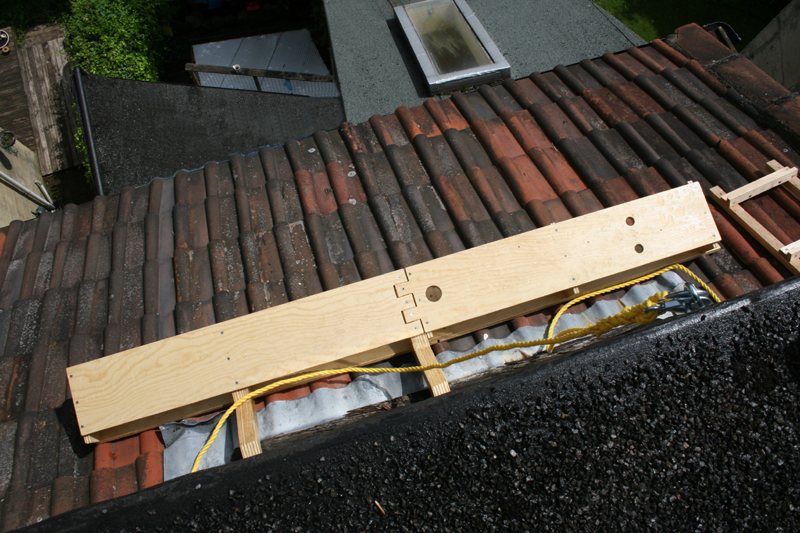
         The JKB Window Hook roof platform is a custom built device for hooking onto a dormer window and resting on the roof tiles in order to undertake repairs/maintenance. It saves hundreds of pounds in scaffolding costs and can be stored away in two separate parts after use. Made from stout 18mm exterior grade plywood and sandwiched at the hook in three thicknesses of material, it is screwed and glued together and lacquered with two coats of matt polyurethane varnish and one top coat of yacht varnish. Job done!


The JKB Window Hook platform. Copyright Jeremy Broun 2012


      It took longer to design the concept than build it and its hook profile and general angled geometry is made to measure for my particular roof. I had already constructed a roof ladder (see my You Tube WOODOMAIN channel) from a couple of bundles of batten so this is also a very low cost solution for servicing my roof and dormer window. Both sections of the platform are 48" long, conveniently coming out of an eight by four sheet and it makes lifting into position and storage easier. 


Looking down on the platform from the dormer window flat roof

        There is an extra hitch point where the two holes are to anchor the end of the platform to the dormer roof upright. I used rope but envisage constructing a metal strap that simply hooks into place. The two sections are fixed together in situ with stout stainless steel screws with the larger hole as a viewing hole to locate the screw. Each section is light enough to manoeuvre through the dormer window opening and fix into place on the roof and the hooks amply clear the window sill and flashing if repairs are needed there, which in my case they did. 


The platform is made in two sections for ease of mobility and storage


 If you are a woodworker/housebuilder who would like to use my idea all I ask for is an acknowledgment or better still buy my Routing DVDs (from WOODOMAIN.com) as a thank you for my ideas. It would cost me too much to patent many of my ideas but I believe in the universal law of what goes around comes around. My device may be featured in a future issue of 'British Woodworking' magazine as an example of resourceful woodworking. I intend doing my own roof repairs for as long as I am active. If you use the idea and make a similar window hook platform I cannot accept any responsibility for its safety, not least because build quality is important. If you are 25 stone heavy obviously the way I have built mine would not be strong enough. Safety always comes first and it is imperative to use an anchored safety harness when working on a roof.


.

Saturday, 1 September 2012

Passion for design

        Probably the most successful British chair of the 20th Century is the polypropylene  stacking chair by Robin Day for Hille International. The tooling costs were around £6,000 and it retailed at under £5. I was always inspired as a designer maker by the giants of mass produced innovation and found myself an increasingly reluctant member of an exclusive social club - British Designer Makers from the 1970's onwards.  I did work on the shop floor of a furniture factory as a trainee designer in 1973 but found the British mass production furniture industry depressing in the 1970's.


Stacking chair by Robin Day for Hille (1966)


      However, another icon of late 20th Century furniture design recently caught my eye in a local 'junk' shop which was a must have for me - four 'Supporto' chairs by Fred Scott, also for Hille International. I only want one for my quirky office but I am having to buy all four and hope to pass the others on. This is the classic original ergonomically designed modern office chair but most in my heritage city would be ignorant of its existence.


'Supporto' chair by Fred Scott for Hille (1979)


      It is not the first time I have picked up a scoop locally. A couple of decades ago. I picked up a classic Harry Bertoia chair from my local market for £5 and use that in my home. Who is Harry Bertoia you ask? We know who Simon Colwell and Cheryl Cole are! 


Harry Bertoia chair (1957)


         But back to the plot - my passion for furniture design is re-kindled when I see a classic modern chair and my home is just too full of chairs so I am having to build a separate sealed storage area for my micro museum! The very first chair I made was actually a copy of 'The Chair' by Hans Wegner and I delighted in spokeshaving the arms which are highly sculptural. I made it out of teak when I was 17 and it was one of my major pieces when I was at Shoreditch College, so I must have made that chair in 1966 and all it needs today is a fresh smearing of Danish oil. The cane seat is still immaculate despite occasional use over the years. 


'The chair' by Hans Vegner (1949)

I think it is important to know our history. I visited the Cheltenham Celebration of Craftsmanship exhibition last week and apart from feeling somewhat let down by the chairs on show (the public chair competition), noticed a table by a maker that was an exact copy of a table by a designer maker friend of mine - John Coleman in the 1980's. I actually could not bring myself to mention this to the exhibitor so here I am referring to it on my blog. But surely in this age of 'graduate masters degree' furniture maker they have studied their history, especially the recent history of designer makers? In my Furniture Today DVDs the history is detailed with hundreds of images of furniture design and many colleges stock my DVDs. 


Veneered Table by John Coleman 
'Maker Designers Today' exhibition at Camden Arts Centre 1984


         I am certainly not accusing this maker of blatant copying as the design possesses a certain structural rationale that could be conceived by more than one mind. But in a previous exhibition there was a submission for not just a direct copy of a classic design but the design itself, a stool was used and the top just re-veneered in burn walnut which stuck out like a sore thumb! I alerted the exhibition curator but goodness me I am not a member of the design Police but just surprised by ignorance in this graduate craft culture. 


Laminated birch stool by Alvar Aalto (1933)

          The wonderful thing about furniture design history is that it may be far from popular culture but it has a lasting and satisfying dimension to it and something to pass on. On my 90th birthday I intend holding a retrospective exhibition of my furniture designs and also show my chair collection which one day will be handed down.


  Cantilever chair in elm by Jeremy Broun (1984)
 inspired by Marcel Breuer's 'Chair with no legs' (1927)


          The designer Ron Arad once said to me 'a chair should have a very good reason for being'*. I would agree with that. It would be arrogant to claim total originality as we all know ideas come from somewhere and I think at least if one is inspired by one design to create another, the source should at least be acknowledged as a respect for that designer. But what does that silly old-fashioned term 'respect ' mean today? 

* 'The Chair' video 1990 (now on DVD) by Jeremy Broun

Wednesday, 15 August 2012

The late Andrew Varah

        Andrew Varah died in July 2012, delivering something of a shock to the British bespoke furniture making community where he had become a distinguished figure; the bloke I recall from my student days, who always sat at the top table, and where after a late start in the furniture making world, he arrived. It was little surprise he was ambitious as he was the son of Chad Varah, the founder of the Samaritans suicide telephone line, member of MENSA and his mother, head of the Mothers Union Europe. Andy was a triplet and identical twin.
        I first met Andrew in 1963 as a fellow student at the legendary Shoreditch Teacher Training College in Surrey. In our second year Andrew got me a room in the sought after old college building alongside his close mates Geoff Buckland, John Eustace and Max Carter. I suppose the obvious thing we all had in common was that we spoke without an accent and so it was probably a class thing. I guess in retrospect we were an elite group although I saw ourselves as different rather than better than the main core of trainee handicraft teachers. We tended to be more independent minded.
           Shoreditch College was a fantastic training not just in woodworking skills but in other craft disciplines such as metalworking, basketmaking, pottery and bookbinding and we had the very best practitioners in the country as tutors. My God those were the days and I shed a tear on the very last day of my training looking over Runnymede from the college campus, thinking it will never be as good as this again. Shoreditch was renowned for supplying not only the best teachers but the pranks that went on at the college were legendary.
         From one of the towers in our residential building I recall being roped in by an errant third year student to spray one of the college tutors on duty with a fire water hose and later hiding in Andrew's wardrobe while the search party sifted through the study bedrooms. Andrew was sitting in bed wearing a nightcap, reading a book, innocently pointing to the open window which happened to be four storeys up and telling the tutor 'maybe they went that way'. I was nearly kicked out as an example to other students but I went on to gain a Distinction on the Advanced Woodwork course while Andrew became social secretary and was out with the girls rather than pushing his cabinetmaking skills. 
      Andy helped me buy my first Morgan three-wheeler and we drove out to secluded pubs in Virginia Water in it and even attended a party in Surrey held by John Gregson the actor. The three-wheeler had no reverse gear and on one occasion we plunged through somebody's garden fence in Bagshot. We shared many fun experiences lasting into our thirties. 


The first 1933 Morgan three-wheeler arrives on the Shoreditch College campus
in 1962, causing a sensation amongst students and staff. 

I took Andy salmon poaching on wild Scottish rivers (my home was in Scotland) and on our last day of the trip I said  'I can't send you back to London empty handed'. While my older sister stood lookout for the bailiff, I hooked the salmon and Andrew landed it. 


I hooked the salmon and Andy landed it
 - an apt description of our furniture making careers. (1968)

On a furniture travel scholarship abroad my car was stolen and he offered to drive over to Holland to pick me up. I managed to get an old banger and arrived back from a 24-hour drive straight from Italy to his barn workshops near Rugby and he was the first to see all the exciting items of innovative furniture I had been given.


The old banger loaded with gifts from Artek, Cassina Artemide etc 
- first port of call Andrew Varah's pad 1979

     At the beginning of our careers Andrew and I taught in tough London schools and met up in our respective school workshops after school hours to brainstorm designs for school projects. We were pioneers of design in schools a decade before Design Craft Technology became officially part of the curriculum. We both left teaching after two years and Andy went to work in Zambia running a furniture factory. He invited me over to be his designer but my phobia for injections stopped that. He returned around 1974 but in preceding years had written to me many times asking what it was like to be a 'designer maker' and saying he wanted to do what I was doing back in England. 
    He set up as a solo maker and so our contact was much closer. I visited him many times at Little Walton, mucking into the renovations of his barn workshop. He had a fantastic pad while I was working in a tiny underground city workshop without natural light. A strange contrast as at the time he was an unknown and I was well acknowledged in the field by galleries and magazines. Around 1979
I introduced him to the Prestcote Gallery and remember his very first exhibit there, an inlaid table in ash. It was a electric time as the new boys exhibited alongside the old boys; A Fred Baier chair sitting next to an Edward Barnsley table.


An ash table by Andrew Varah circa 1976


Perhaps ashamed of my own somewhat modest workshop I turned down an opportunity in 1989 to be filmed for a regional television craft documentary and introduced the film director Trevor Hill to Andrew Varah who at that time had just taken on the genius woodworker Andrew Whately from John Makepeace's workshop. I think it was Andrew's first television exposure and at that time a rare insight into the work of furniture designer makers. Jan Leeming, ex News reader was the presenter. 


A chair by Andrew Varah around the time of the first television feature 

     Andrew delighted in pleasing his clients and working to their needs, often adding whims drawn from different architectural periods making his actual designs somewhat derivative and overplayed in clever craftsmanship in my opinion. I felt he became a bit of an 'untouchable' in terms of design critique but then there are no critics of bespoke modern furniture! If it were a West End play the performances would be torn apart by ruthless critics (Kiera Knightly playing Anna Karenina)! But design apart, Andrew Varah became a formidable maker and guiding light to a new blossoming generation of furniture designer makers. It was the late Alan Peters (who also trained at Shoreditch College) who said in 1974 this is surely the most difficult craft to sustain.  
        I still have some prime quality flitch cut English oak Andrew sold me at cost price in the year of the drought in 1976 and some Rio rosewood veneer he gave me on the same occasion. In our halcyon days Andy would often get to meet the girls I dated and would say 'I can't believe how you can pull the most beautiful birds' yet he could pull the most prestigious clients and was really in a different league running a furniture business and employing talented young craftsmen, many of whom stayed for decades.
 There was obviously rivalry between Andrew nyself. Even as students he once told me he could run as fast without training as his identical twin brother Mike who was running 800 yards for Britain. I told him he was arrogant and challenged him to run around the college track. He beat me after 26 laps and I was in the college athletics team and he wasn't! Curiously as my furniture 'career' suffered because of depression in my life I once admitted to Andy I had often phoned up his old man's outfit the Samaritans. I got the impression Andy did not get to see much of his father in his youth. Despite our more recent fall outs, we exchanged an amicable conversation at our last chance meeting at an exhibition in Cheltenham where we were both judges for different awards. 
      I made a film including him called 'Five Ways to Fashion Wood' in 1989 and a light-hearted clip called 'Three wise men' in 2005:  


Inevitably Andy and I followed different paths, but nothing can take away our early formative and fun years.  Varah RIP. 

Tuesday, 10 July 2012

Fear of wood

     Many years ago a well known award winning local architect  was tragically killed whilst chainsawing a tree on his land. It fell on top of him and one immediately thought how could this happen to such an intelligent well organised person but it also served as a reminder of the yin and yang of life, that wood is a provider but one could also potentially die from a splinter. 
      For much of my life I was blessed with a wonderful gift of confidence to do anything with wood, I had no fears and nearly twenty years ago when totally re designing and re building the roof of my home I also built timber scaffolding out of two by two which I left up for nearly a decade on the back of my house! 
     In a previous blog I described my near escape from death last November when I clambered onto the roof to do some repairs and found I did not have the strength to pull myself up onto the dormer window roof. Well I found the strength hence I am here to write this but am now faced with the same challenge of sorting the roof out and building a stable platform. The problem is I am terrified of setting foot on the 45 degree roof pitch quite apart from avoiding looking down four storeys. I used to be a rock climber at school and followed the A team up the Derbyshire gritstone Black Rocks in just gym shoes and no ropes. I never experienced this fear before and although I am sketching out designs for a timber scaffolding structure to hook over the ridge I have the fear for the first time in my life that wood will fail me, that however I construct the scaffolding the fibres might tear, the screws might sheer etcetera etcetera. 
     Fear is a dangerous thing! So I am provaricating/procastinating and making extremely slow progress and fearing the very thing that has given me joy and confidence since I was sixteen - wood. So as you go through life, not knowing why you are here or how long you will be here for and stepping outside the social conditioning of leaving the nest and creating your own little nest and following the conveyor belt of life, drinking beer and following football teams on the way what else is there?!
    Some might stop to ponder at how life seems to deal out certain cards at different times and that some of those cards maybe interpreted as lessons. Is it merely a game of Monopoly at the rolling of dice? 'Go to gaol', 'collect a wife' or 'collect diabetes as you pass'? Of course one of the lessons taught is you can't take it with you but obviously not a lesson learned as money is seemingly even more of a God today. The late Paul Getty, richest oilman on the planet in the 70's (whose art foundation once purchased one of my furniture designs) had a deep fear of poverty and brought himself up from the gutter, so fear can be a great motivator as well as energy seeper. Certainly thinking too much can be a serious damper. 
    On my observations even the most clever people appear to think very little about major life events in the sense of cause and effect and just as the 'nature versus nurture' argument persists I also wonder if being master of your destiny or victim of fate is a similar puzzle? Certainly no one I know is in control of their lives but it keeps you sane to think you are. Now, lets get over this silly fear of wood and start thinking positive again. In fact, better than that - get back to the doing.        

Thursday, 5 April 2012

Murphy's Radio

       Many will know the colour and style of Cheryl Cole's hair, few will know who Cheryl Cole is and everybody knows who Simon Cowell is. Few will know that in 1934 Gordon Russell made Murphy radios and few will know who Gordon Russell was.
       It was on BBC 4's Today programme that I woke up today to the words  'Gordon Russell was one of the greatest designers of the Twentieth Century'. Not only one of the greatest designers, I have chosen to refer to Sir Gordon Russell as 'The Father of 20th Century British Furniture Design' in my film documentary 'Furniture today 3' (available at www.furnituretodayuk.com). 
       Gordon Russell was a hugely important figure having been involved with The Festival of Britain, The Design Council and Utility Furniture. It is perhaps Utility Furniture that strikes the main chord with me; functional simple furniture designs born out of necessity when there were material shortages during the Second World War and made in modest workshops around the country. A lesson indeed for furniture students to toughen up and design to a disciplined brief but above all making furniture accessible. 
      Gordon Russell although inspired by the Arts & Crafts and in particular the understated forms of Ernest Gimson, differed with that movement in his total acceptance of the machine embracing it with hand skill. Such snobbery or indeed ignorance still exists today not least in the minds of a small section of the public who expect a crafted object to be totally made by hand.  Even in the sweat shops of India and China the machine is fast replacing handskill. Curiously, William Morris a pioneer of the English Arts & Crafts movement cried 'Let us be masters of machines not their slaves', but his work was predominantly taken up by the Bloomsbury Set and still assumes a whiff of exclusivity today.
     The BBC Radio Four design competition for amateurs to design a radio sounds a great inititiative. Let's hope some innovative wooden radios will persuade the judges. For many years I have listened to a Roberts radio in my workshop, a plywood chassis housed in solid Teak. Today Roberts Radio fill the shelves of Currys stores shining in their glossy plastic. Arguably modern technology transcends the superiority of wood as a sound baffle although I still have some massive "Class A" KEF speakers I built in 1970 using chipboard.
    One of the features of Gordon Russell Utility furniture was the use of thin plywood for door panels. Plywood for much of my furniture making career was looked down upon. A local furniture shop declined my plywood rocking chairs saying 'the public don't like plywood'. Russell, of course, was building airplanes for the War Effort and plywood was clearly a superior material then. 
       Unlike Murphy's Law, Murphy radios seldom went wrong!


A Murphy radio built at the Gordon Russell factory in Broadway in1934
Veneered plywood would have been used in the construction.

Tuesday, 27 December 2011

The Buzzword is Making Things

    The great thing about a blog is that you can say what you want without a magazine editor changing or messing up what you have written. The downside is that hardly anyone reads a blog unless you are a celeb. 
    Today's blog is about a true celeb in my life and that is my woodwork teacher. He more than anyone else has influenced my life - a true genius of a teacher and such is this man's modesty I could only find one Google result (below) about a Telegraph article about him riding a Royal Enfield Bullet in 2001. Curiously I owned one of those motorcycles as well as follow Howard in his footsteps and train at the legendary Shoreditch College as a Handicrafts teacher on leaving school. We were well ahead of the game teaching youngsters how to think creatively as well as use their hands. We were teaching design as an integrated part of Handicraft years before Design took over and eventually became embedded in Technology. The buzzword now is 'Making Things'. A bit late when the subject has been systemmatically dismantled over decades! 
    Howard Orme became woodwork master at Abbotsholme school as I entered the Lower Sixth form having failed Woodwork O level with the rest of the class under the previous uninspiring teacher who swiftly vanished. In the December resits I got 85% and two terms later Grade A at GCE A level (normally a two year course)! The thing about Howard, apart from him having a very glamourous young wife at this all boys' boarding school was that he was mildly eccentric and a damned good cabinetmaker as well as an inspiring teacher. Enthusiasm is what comes to mind and this certainly rubbed off, but he must have liked me and for someone who spent much of his school life in trouble that was quite something. 
    My father died when I was 17 and the headmaster gave me the day off lessons to be quiet and on my own. I took the day off fly fishing on the River Dove and feel no remorse in saying it was the first day of my freedom and so I guess Howard would have become a role model. He made learning woodwork fun and even gave me the keys to the woodwork shop one Friday night to make my first guitar. I worked throughout Friday and Saturday night and slumped over the bench around 4pm on the Sunday with one completed acoustic guitar. We had run out of French polish so I used shoe polish.  It was an exciting moment of truth to string the guitar and it sounded good. 
   Above all Howard was a superb craftsman and he would invite me to his flat to inspect his cabinets while his lovely young wife made coffee! Howard had just left the RAF and I guess he was about 23 years old when he joined the Abbotsholme teaching staff.
   On one occasion the headmaster brought some parents of a prospective new boy into the workshop. Howard and I were competing on mini crossbows we had made aiming at a poster of Edward Barnsley at the far end of the workshop. The headmaster was speechless but this was an independent progressive school and I was Howard's star pupil. 
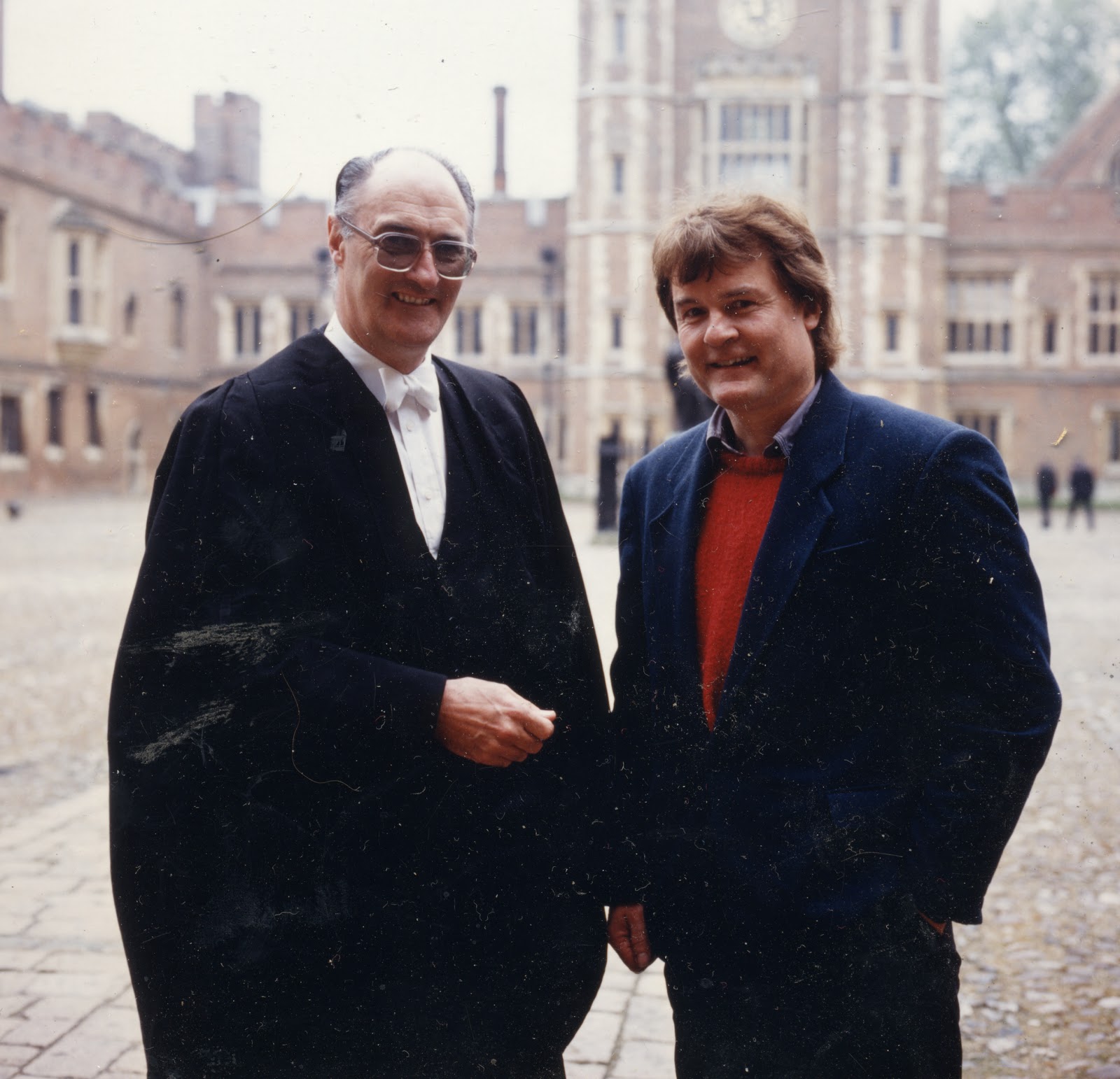
    I dedicated one of my woodworking books to Howard Orme and later met up with him at Eton College where he took up a post in what he described as the Department of Maniacs (Mechanics).  I don't think Howard ever really knew how much he had influenced me and not just in a selfish way of my becoming a renowned designer maker but more importantly to hand on the gift of education and in particular the undervalued Practical Arts that was my particular vehicle for personal development and expression. The greatest reward and one more lasting than the acclaim of (transient) fame as performer is when out of the blue ten, twenty or thirty years on an ex pupil or student appears out of nowhere and says you helped them find their direction in life. Especially in the field of teaching when at the time you have no real measure of whether you are any good at all.
However, one thing for sure is that anybody in the business of education - a teacher, has no business there unless they have not just enthusiasm but a passion for what they are teaching. A university degree proving you are clever is not enough. 


Jeremy Broun with teacher Howard Orme at Abbotsholme School


Howard Orme and Jeremy Broun at Eton College where Howard taught


Howard Orme's Telegraph article:

http://www.telegraph.co.uk/motoring/4753067/Typical-biker-Howard-Orme.html

Sunday, 30 October 2011

Flat pack hunter gatherer

  Apparantly part of Swedish furniture giant IKEA's success is that it appeals to male hunter gatherer instinct. Insert four scan bolts in pre-drilled holes and hey presto I've made the wife a piece of furniture.
Despite IKEA being a Global innovator the concept of flat pack furniture probably dates back to at least the English Tudor period in the gateleg table. Well, it packed flat enough to be freighted on a horse and cart! The one common link is the use of oak, probably the most durable of timbers. Of course durability and IKEA are never mentioned in the same breath but you would be surprised how attitude towards a piece of furniture makes a difference. The testing of IKEA products is not only vigorous and extensive, but if looked after many of the products do actually last.
   Discovering my passion for furniture design as a young man I would have preferred to design for a company like IKEA but I was working 20 years before they dared come to Britain (we were too backward looking for the company who by 1979 operated in 26 other countries).  Some of my designs in the 70's could easily have sold in IKEA stores since the 90's but my only career option was to become a solo designer maker as the UK furniture industry was so hidebound. Faced with the choice of creating designs at a reasonable price that give pleasure to many people or making very expensive one offs for an exclusive market my preference still remains the same 40 years on. There shouldn't be an either or choice but the market tends to dictate.
   It is highly unlikely my own furniture innovations will ever sit in museums such as the V & A but I can take great personal pride that my High backed rocker in particular has found hundreds of homes worldwide, is usable and accessible to ordinary people and some are now being handed down (see image in 'My beautiful hands').  I did produce a plywood flatpack version in the late 70's which was turned down by a local furniture retail shop. 'The public don't like plywood' the shop owner declared.
  

   The Early Tudor Gateleg Table - forerunner to flat pack furniture?


An IKEA room set photographed by Jeremy Broun in 1979 on his visit to 
the original Stockholm store as part of a Churchill Travel Scholarship.


A sturdy oak dining chair from IKEA in 2006. The main downside of pack flat furniture
 is the failure of the consumer to tighten the bolts a few months after the furniture has
 settled into the room environment. Solid wood shrinks and expands.


A flat pack ash rocker designed by Jeremy Broun (1980).
Don't forget to tighten the scan bolts.

Friday, 21 October 2011

Furniture Today

   I am working on 'Furniture Today Part Three', a DVD project I began in 1998. At that time it was mostly furniture 'yesterday' as Britain was drowning in its heritage through fear of the looming Millennium. Of course the title demands frequent updates as the first production was in 2006 and especially now as furniture 'today' has truly come of age.  It is a mammoth task as the field has expanded so much in just the last decade and there is fantastic work going on that is outside popular culture. It is a self-funded project, (the usual suspects rejected my requests). Nobody asked me to do it and unlike Parts One and Two when makers I approached were very responsive to submit material, I am struggling to get makers to respond. I suspect some might fear I will be too outspoken! Yes, I will be outspoken but objective and analytical. If an extremely expensive piece of furniture has technical flaws somebody should surely comment on that?  Be thankful my name isn't Jeremy Clarkson!  It is bizarre to think that conventionally film production involves a team of specialists and I am doing everything single-handed!


Self-taught film maker Jeremy Broun using a Super 8 cine camera in 1984

   There is virtually no serious in depth debate about furniture. The last broadsheet newspaper critic was Peta Levi who passed away (since I featured her in 'Furniture Today Part Two'). I suppose furniture design and woodworking is a passion of mine.
   I am struggling today to work on the project - endless hours of editing film footage, promoting the work of others, when depression drains energy. But I know, despite the struggle, I will make a good job of this update of what is a unique visual document of the best contemporary furniture being made in the British Isles (indeed some of the very best in the world) and placing it in a historical context dating back to the Magna Carta. As Churchill said 'History will be kind to me as I intend to write it'!

   The Zigzag Table by Jeremy Broun. First designed in 1978 this example made in 1984 and the last one commissioned in 2007. Each one is slightly different in size, material and detail.

'It exploits the markings of traditional manufacture, as seen in the wood joints where the top meets the legs, and it is innovative in its centre joint. Limited edition designer furniture provides the closest link between maker and user, and often results in the most interesting products'.

from 'An Encyclopedia of Tables' by Simon Yates (The Apple Press - Quintet Books) 

Thursday, 6 October 2011

Come back when youre famous

   I think it was the year of 1973 and I was working in a converted cattleshed workshop on the outskirts of Bath. The rent was £5 per week. I called myself 'The Bath Carpenter' and took on a variety of work ranging from trimming the bottom of doors (fitted carpets had made their debut then0, to building fitted wardrobes and kitchens which paid the way for me to speculate on my individualistic contemporary furniture designs. I used an anonymous title as I felt good design should sell on its own merits rather than rely on a name, a rather naive view.
   There were no outlets for my furniture. It was too modern. I did manage to persuade the owner of a local Persian Carpet shop to put one of my rocking chairs in front of one of his expensive carpets in the window and he took just ten percent.
   There were two craft galleries in Bath at the time; Coexistence and Centaur Designs. I remember the tall female owner of Coexistence looking down on me and asking whether I had been to the Royal College of Art. I had more breeding in my little toe! I politely withdrew from her exclusive gallery and walked across the road to Centaur Designs with my portfolio. I showed a picture of my rocking chair and said it had been selected for a major London exhibition called "Wood". In his put down I recall the proprietor saying 'Let's wait and see what happens from the London exhibition' which in effect was code for 'come back when you are famous'.
   A few years later a gallery owner in the north of England telephoned me invited me to show my work at an exhibition. I asked her didn't she want to see my portfolio. 'No she said' reassuringly 'That's not necessary, we know your work'.
   2011 footnote: Was this licence to put in a Grayson Perry type appearance?


 The converted cattleshed workshop in Milton Avenue, Bath


A short extract from 'Missing Jean' by Jeremy Broun

Friday, 30 September 2011

Dovetails - The Holy Grail

   In the world of woodworking there is nothing more striking than a dovetail joint and what it represents historically. Many still argue it is the strongest joint and when it come to cutting dovetails they have to be cut almost according to the gospel. 
   But I find it a little irksome when I see immaculate cabinetry at exhibitions and when I open the drawer I see the shoulder line left on. No, no, no. If you are going to stick to tradition stick to tradition! I also observe inconsistency as the shoulder line is never left on the carcase dovetail! 
   So who is the gospel according to? Well if we take the 50's and 60's as the zenith of handmade cabinetry, before machine woodworking got into gear, a Mr Charles Hayward was famous for a series of definitive books on practical woodworking and he was pretty well acknowledged as the authority. In fact nobody since has gone into the craft in anywhere near the depth of his books. He states clearly that the shoulder line should be removed and this teaching at the same time was coming out of the leading colleges Shoreditch and Loughborough. A light shoulder is first scribed and then deepened where the tail and pin portions are removed. the line there serves as a location for a chisel and saw. 
   Although many antiques display crude shoulder lines left on which on close inspection by the torn grain imply a marking gauge was used (rather than a try square and marking knife), it is no guide to proper practice or the best tradition. Many antiques were made by semi skilled craftsman and are so badly designed and made would be thrown out of an exhibition of contemporary furniture today.    
   Here endeth the lesson!

A carcase dovetail devised by Jeremy Broun combining a traditional lap dovetail and through dovetail.
This is a short extract from an article to appear in British Woodworking magazine soon

Tuesday, 27 September 2011

My Beautiful Hands

   A few days ago I did a stupid thing and whilst using a portable metal grinder the molegrips slackened, the metal moved and the rotating cutter went quick walkabouts over my hand ripping through a layer of flesh around the base of my thumb. Fortunately no nerves or tendons were severed as this is my right hand used for guitar playing and my thumb is very important. The last time I damaged a hand was also whilst working on a car project in 1989 and I drilled through the bodywork with a half inch drillbit, forgetting I was supporting the material with my fingers the other side. In fact it was the same thumb! Complete stupidity and a reminder how valuable my hands are. 
   I often lie awake at night silhouetting my hands against the moon shining through a skylight above my bed. I still have beautiful hands, strong working man's hands but also well proportioned hands with guitar player's fingers. I don't think its vanity but a sheer appreciation of the wonder of how the hands interpret what the brain commands. I exercise my hands whilst doing my full moon ritual, making the fingers move in every possible way. Learning guitar chords (or any instrument probably) is an excellent workout for hand and brain.
Some guitar chord shapes take tens of hours to master from the initial careful placing of each finger on each string, often awkward to hold the position, then months later the chord shape is executed at speed. I'm lucky, although I used to be able to site read, I play totally by ear and once the muscle memory kicks in the chord sequences are automatic and I can then concentrate on expression. I am amazed at how many jazz players read off the manuscript. I thought jazz was supposed to be free and improvised. I am an improvisor and my wonderful hands are the greatest gift I could ever ask for, linked to a brain that fires on four cylinders most of the time. I am very fortunate, at this moment in time I have no aches and pains in my limbs and in particular my hands and it is surprising I have not worn my hands out. 
   I have made a living from my hands, renovated three houses and made countless pieces of furniture. On my rocking chairs alone I have drilled nearly forty thousand holes through which eight miles of sailing cord has passed to create the upholstery (although many of the chairs were woven by others) but I drilled every hole. 
   Over five decades of using my hands since building my first guitar at school, I reckon this represents between 30,000 and 50,000 hours of creative hand work and still they are almost as agile as when I was 17 years old. This takes into account a fair percentage of my life immobilised by depression. Perhaps the price I pay for such wonderful hands.


  My beautiful hands that survived a stupid accident

The High Backed Rocker has found homes around the world since 1973
Over eight miles of sailing chord and 40,000 holes drilled