I was talking with somebody the other day and we got onto the subject of trainspotting in our youth. I was encouraged to try it out when I was about ten and survived a few days ticking off the train identification numbers in an 'I spy' book when they passed through Chippenham station. I subsequently preferred identifying cars. However, in conversation with this bloke he mentioned the term 'Fudgers Junction' which I thought would make a catchy title for one of my You Tube (Woodomain) videos. It means a trainspotter who makes a false claim about a train such as the Flying Scotsman having been spotted in say - Redruth, Cornwall when in fact it never ventured down there (so I'm told).
It crossed my mind whether the term might apply to woodworking - for instance a secret mitred dovetail is a highly complicated joint to achieve and a real sign of masterly craftsmanship but all you see actually is a mitre from the outside, so who knows - could this be a case of Fudgers Junction?
And then what about all those designer makers who don't actually make the designs that come under their name (on the price tag) at the auction houses? Even Chippendale might have been a Fudgers Junction kind of guy. I think there are quite a lot around and if over the many years of woodworking and furniture that I have made with my own bare hands, and creations that are entirely mine and not derivations of others' ideas, the only epitaph I deserve in my contribution to the world of woodworking, is 'the guy who introduced Fudgers Junction to woodworking', then, all I ask is that you don't confuse me with a 'bodger' or a more commonly used term that seems to resemble fudger!
Ebooks have been around for a few years and I've been keeping a watchful eye on progress with a view to publishing my own woodworking titles online. With the recent launch of the Amazon Kindle Fire I think its true to say that ebooks have now come of age - well thats if you think the age of being capable of voting is sixteen!
The ebook age is also an age of uncertainty as there are no guarantees the ebooks you can view today will be viewable in five or ten years time. Many of the formats listed on Wikipedia are now obsolete and even when you think all the boxes have been ticked, its a bit like a radio station - it only needs to be slightly out of tune and you miss out completely on the message. Not only are there several different ebook formats out there but they require different readers and are exclusive to the major distributors/platforms such as Kobo, Kindle and iPad. The one that keeps on coming up is E-pub and when I enthusiastically contacted The British Library with a view to loan out my e-books was informed this is the only format accepted by their supplier.
It is a can of worms as I have spent the past month or two experimenting with some multi-media e-publications (including video embedding) that are the perfect platform for my intended market, except it use the old-fashioned 'Flash' protocol that has got many slick websites into trouble in recent years. Well I have been doing some research, reading forums, listening to what Adobe has to say about flash and HTML5 and they are not about to dump it. This heartening as you only need to look at the frantic launch of ever increasing social networking sites to throw the dice and reckon what will still be around in five years time.
Now, I'm fortunately in a market that is not primarily dictated to by fashion and the thrill of change. Lets face it some of my customers for videos (on average over 55 years old) are still using VCR's and although we have been told that DVD is obselete it will run on and so too is the consensus regarding Flash. Almost 99% of computers have flash installed and the FlippingBook software I am trying out currently is also HTML5 enabled so it loads on mobile devices.
I like this particular ebook format because it allows virtually instant access o sample books on my website, unlike most other formats I have tried that involve passwords and lengthy download waits. a particularly useful tool is the word search especially for lengthy technical books and the embedded video just brings it all together as great learning platform. Well, see what you think:
I have just been watching the tail end of an interesting TV documentary about creativity and advertising and it focused on stand-up comedians (Gags to Riches) and how doing TV commercials is considered stooping amongst many of their peers. Some would also reasonably say that earning vast fortunes by doing an advert pays for the more creative work as even well known actors can fall on hard times and this is true across the creative spectrum in Britain.
Certainly as a furniture designer I have been too fuelled by a desire to innovate new ideas to fall into the trap of letting clients dominate my output but have relied on building wardrobes, fitted kitchens and even site carpentry for bread and butter survival (which I've also enjoyed doing).
In the programme John Cleese said about creativity 'Wherever you look now money spoiled it'. Ironically one of his well known creative achievements was in his series of business training videos (late 70's I think) using humour as a potent learning tool - to improve a business which generally means to make more money! However, I find his statement does ring true in my own observation of the field of bespoke designer maker furniture that I have seen develop from its infancy.
There has undoubtedly been a Golden Age of British Craftsmanship and design (that I have enjoyed documenting) but it may have passed its zenith, not because there is a recession to potentially stop it in its tracks and furniture really is a luxury, but because increasingly high prices and associated exclusivity have dominated the field which translated means the client has more of a say in what is created and that can lead to creative compromise. Well, thats my view and also my observation in my own field that a high degree of clever persuasion is involved in getting your own way and possibly the people at the top of their field have more swing to do just that!
Many would argue that designing, as a problem solving activity, includes the client brief and this does challenge definitions such as the old well worn question 'is it art, is it craft, is it design?' So in wearing my hat as fundamentally a furniture 'artist' the buzz for me in searching for exciting new ways to make things is essentially a selfish quest where the hope is someone will like it enough to buy it and put bread on the table. For most of my working life it has been more a case of the butter on the bread as I had the good fortune (and interest) to be able to teach also as a supplement to my income.
The true creativity I believe connects with a curious breed of people called early adopters and in the world of mass-produced items they will pay a little over the odds (e.g. in the days of Hi-Fi) and I do believe some other mysterious forces are at work in bringing the creative individual in touch with the early adopter just before the former is about to go bankrupt! That is not to say early adopters are rich but that they recognise the uniqueness of an idea well before possibly it (or the creator) has become a brand. Not all early adopters are looking for an investment as I believe many are simply connecting on this other level with the creator!
These are just rambled thoughts in response to the statement John Cleese made that stuck in my mind and the point I believe he (and others) was making was that if you want creativity, don't interfere with it and see what comes out of process as even the creator will not know. It cannot be prescribed.
It was whilst at school studying for A level woodwork I made my first acoustic guitar. It was made in a weekend - that is, I started on Friday afternoon and worked through Friday and Saturday night to complete the instrument by tea time sunday afternoon. Normally it takes about two weeks to build a guitar. The school workshop had run out of shellac so I used boot polish. It was probably at Abbotsholme (progressive) school that my desire to innovate and break with tradition began although at that time my training was to be in a strictly traditional groove. Howard Orme was my woodwork master and I followed in his footsteps and went on to train at Shoreditch College. He landed yup teaching at Eton where I met yup with him a few years later.
Woodwork master Howard Orme later meets up with
his first A level student Jeremy Broun.
Howard was quite eccentric and a brilliant teacher. I was his star pupil and the first to gain an A level pass in just two terms instead of two years. Put that down to an inspirational teacher, no less. Once we were in the workshop firing crossbows we had made at a poster of Edward Barnsley at the end of the workshop and the headmaster walked in showing around some prospective parents. Imagine that happening today - well it wouldn't because there are hardly any school workshops for kids to make things in wood!
My father had died in that year and I was somewhat lost regarding the dreaded word career other than the guidance of Howard who helped open the lock to my creativity. I recall thinking then, shall I become a guitar maker and realised I would become bored quickly as guitar making was steeped in tradition. So, almost fifty years and twenty guitars later I decided to spend more time making innovative acoustic guitars with the pledge to make one a year. Of course I never commanded big bucks for my guitars as I was an unknown and guitar making in Britain is probably far more exclusive than bespoke furniture making. I did sell an acoustic 'jumbo' guitar in 1970 for £200 that was a pretty good price.
Jumbo guitar (no 12) with braided strings. 1970
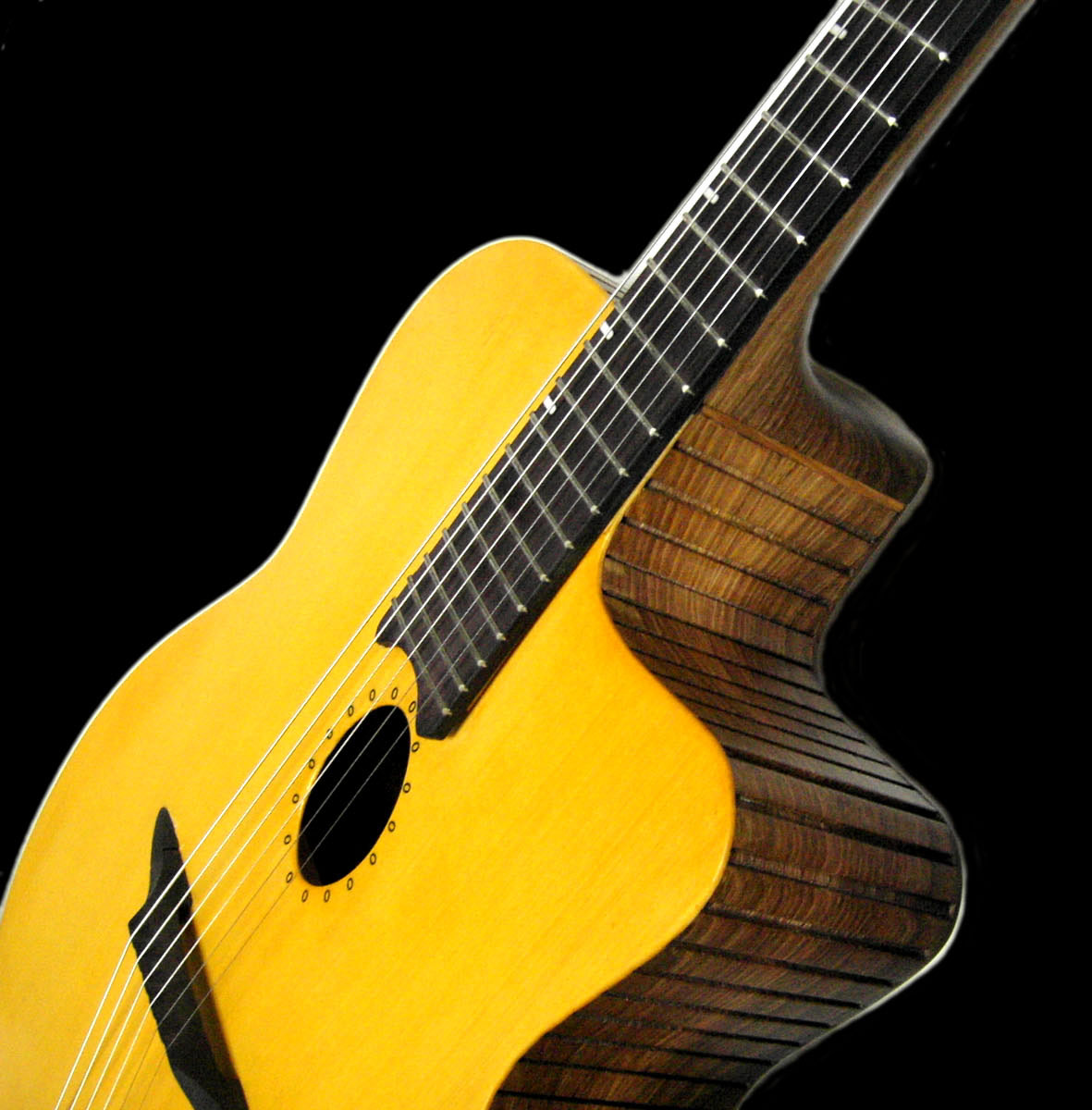
More recently I have made a Selmer style guitar as played by gypsy jazz guitarists. There is a better market there for making custom built guitars but of course Chinese imports have seriously dominated the market and some very fine guitars too.
Selmer style guitar using local walnut with innovative
sawkerf rib construction by Jeremy Broun
Modern electronics adds another dimension to guitar making and I even have a busking guitar case amplifier with wireless sound transmission that I went to Paris with a few years ago.
A current project still at the design sketching stage is a very small travelling electro acoustic guitar that delivers a formidable sound combining micro electronics and the best acoustic wood materials such as Balkan spruce for the top and mahogany for the neck. An acoustic guitar embraces many woodworking techniques exploiting the character of a range of timbers.
An experimental travelling electro acoustic guitar using a Hofner Shorty
One of the joys of working an incredible material like wood is exploring its versatility. Often people are confused when you say you design modern furniture and also make guitars as it is easier and maybe perceived as more professional to say you focus on just one thing and this puts everything into a neat box. But this goes against creativity and the adventure with wood can take you along fascinating diverse paths. Perhaps they all link up somewhere.
Anyone who is familiar with the picturesque Wiltshire town of Bradford On Avon and who was a local artist in the 80's will recall the Brewery in Wine Street. My late half-sister Barbara, an accomplished Trompe 'oeil painter, rented a studio there for £1 a week and went on to create fabulous works of Art for Pop superstars and even a Hollywood film producer. I recall she had painted the old beams and walls in her studio in this semi-derelict building. There were holes gaping in the roof and bits of corrugated iron placed below to channel the rain water. It was a beehive of creative activity, housing stained glass artists, potters, woodworkers et al.
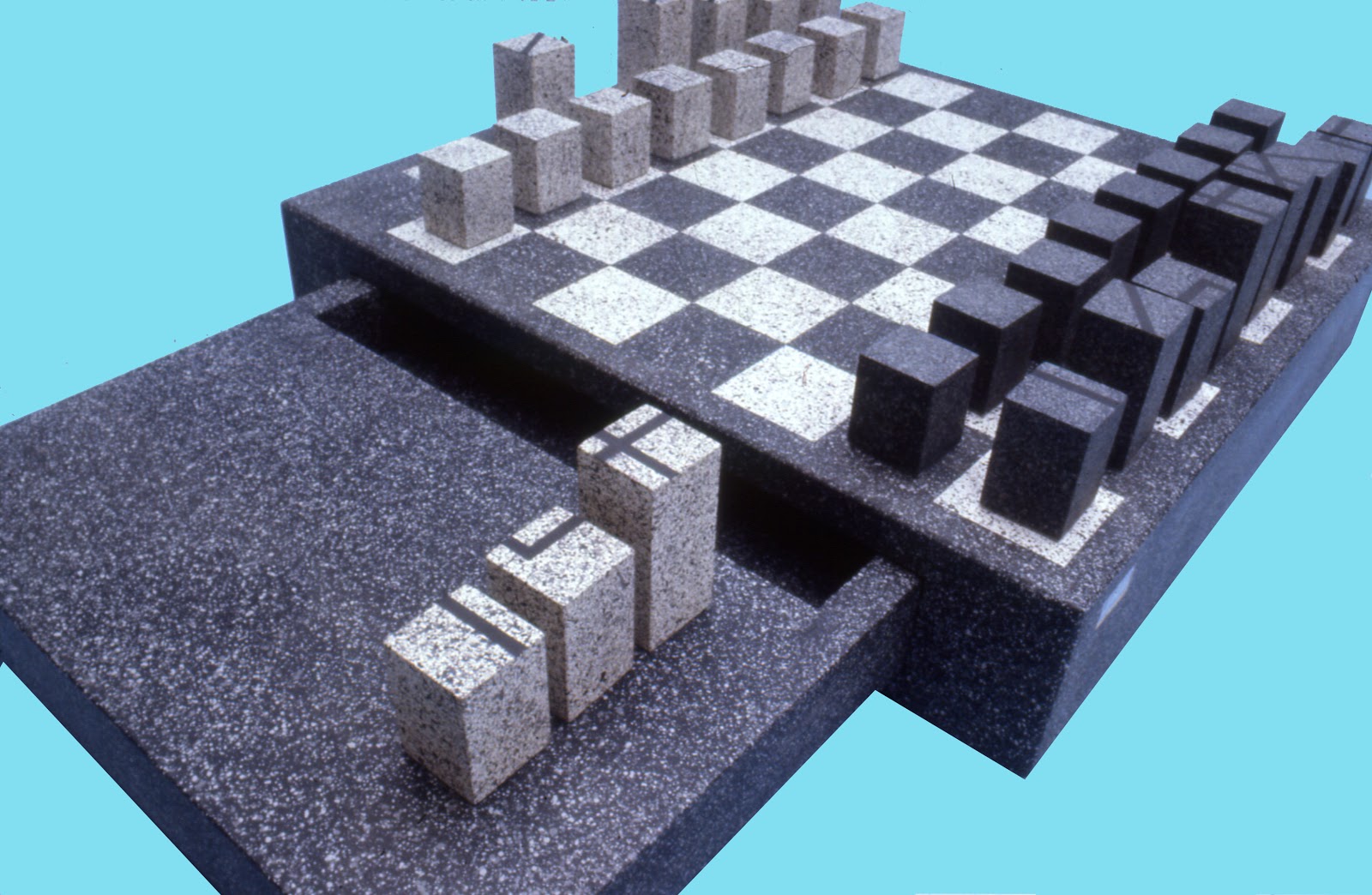
Egyptian Porphyry chess board and pieces designed and made by Jeremy Broun
and painted by Barbara Broun 1981.
Circa 1985 I rented a studio below Barbara's at £5 a week for a short period. I used it primarily for storage as I had sold my house in Bath and was thinking of emigrating to Australia out of rust ration that modern furniture was not appreciated in Britain. What I do recall was that bats inhabited the Brewery and whilst property speculators closed in on all quarters there was a conservation order on the building to protect the bats and that basically kept the rents low for a artist craftsman to struggle to make a living.
Today I was invited to a New Year breakfast at a friend's house near Bradford on Avon and one of the guests, an elderly man, resides in a flat at The Brewery. The developers eventually got their way, but interestingly when I mentioned the bats back in the early 80's he said ' oh they are still there and there is a hole in the roof for them'!
One of the reasons I was able to focus my own furniture on innovation and go against the grain was because I kept my overheads low and this studio similar to the converted cattle shed I rented initially in Bath at £3 per week was vital to that creative survival. The artist craftsmen who resided in Bradford on Avon largely left as property developers moved in and were fragmented around the county or simply had to grin and bear increasing high rents. The conservation of a few bats may seem more important than the patronage of artist craftsmen and little wonder the field I was a pioneer in has become a very expensive playground - possibly now excluding the truly innovative?
I welcome the New year in holding hope that change will occur. The news that Viscount Linley (who once asked me to make his furniture) is no longer trading in his furniture business has implications for this luxury craft and I guess we can go two ways, either become even more expensive or pitch it within the grasp of ordinary people, but then not enough ordinary people are excited enough to live with fabulously modern furniture that lasts so that it can be made on a rational basis (batch production) so the dye is set or at least for a while longer.
In this New Year I'm not quite sure where to go and age isn't exactly on one's side but then I was never certain, just passionate about making new things in wood. All a bit batty really and perhaps one should hang upside down in the dark for inspiration!
One of my passions is that young
people are encouraged to use their hands and minds at school. I
originally trained and taught as a Handicrafts teacher in London. Over my career I have seen the demise of the practical arts in schools yet the creative arts generally are a huge national asset.
Early in 2010 I received an invitation to teach a Saturday
masterclass at Eggars comprehensive school in Hampshire. It was a very successful day involving a team effort of staff at the school with yours truly heading the project I had devised and the mostly 15 year old boys and girls took home to
mum a useful artefect which embodied equally useful woodworking and life
skills.
Jeremy Broun teaches a woodworking masterclass at a Hampshire comprehensive school
It is vital young people develop their potential fully through using the incredible gift of
hands irrespective of whether they get a job as a carpenter or brain
surgeon. That is to the point. Education through the use of materials is what a few of us called
in the 1960's and served as a vehicle for fostering self determination,
acountability, stamina, visualisation, interpreting abstract ideas into
three dimensional objects, numeracy skills, not to mention motor skills
involving the senses of touch, sight, and sound, muscle memory.
Despite
throwing 'craft' out of the curriculum the most enlightened teachers in
the 1960's were doing all of this in an integrated way, (teaching
design as part of making) but the now established Design Technology
curriculum, passes over many of the essential 'making' skills, not least
through a basic misunderstanding that the prime purpose of teaching eg.
woodwork at school is to train a carpenters. That is the role of post
school specialist education.
With the increasing uncertainty of what jobs we are training young
people for (and questioning whether university should be the default
route) there is ever more need to teach them resourcefulness through
making things and designing what they make. Anybody daring to claim it
is too expensive to provide practical education, go raid a skip and use
some valuable secondhand wood that is thrown out daily!
I am course honoured that my skills have not been dumped on a skip and
that a school like this invites someone like me to pass on my skills and
experience. There are plenty of exclusive and very expensive
masterclasses for older people, many switching careers from 'The City'
and encouraged to use equally expensive tools but our obligation is to
future generations and give all young people an equal opportunity to
develop through their hands.
The last time I worked with young people (before the Eggars
Masterclass) was at my local technical college teaching acoustic guitar
making to a group of errant 16 - 19 year olds, some in trouble with the
Police and all lacking in any numeracy or literacy paper qualifications
from their secondary schooling. It wasn't easy and only three survived
out of a group of six but they made their guitars and will probably
always look back on this achievement with pride.
A
simple leaning bookstand exploiting a dovetail designed by Jeremy Broun
and presented to 13 year olds in 1963 made by 15 year olds at a Hampshire comprehensive School in 2010.
Teaching acoustic guitar making on an 'Education to Employment' course in 2005
The little Smart car that is my workhorse is fantastic in many respects - it is small enough for me to park in my overcrowded street where other cars can't fit into the space, it takes daily battle scars of people pulling in on the narrow hill, letting their foot of the foot break or plainly misjudging their car's clearance and banging into the wings of it and I have a box trailer for occasional heavy loads. And it is economic. I can live with the BMW drivers who insist on coming right up to my rear on the open road as I know I can easily blow them away on my motorcycle, but what I find is mind-numbing is a discovery that has temporarily left my intelligently designed little Smart car a piece of useless plastic metal and rubber parked on the road, awaiting a cost effective solution.
Compact, turbo charged 50+mpg Smart Fortwo
Last week after heavy rainfall (that drowned at least one car driver, so I shouldn't complain) as I switched the ignition on, the left flasher came on and stuck on. It later revealed that the engine management system, a tiny 'black box' crammed full of circuitry that controls absolutely everything on the car is sited under the dashboard and right underneath the windscreen that apparently is prone to leaking. So, having owned over a dozen minis in my youth and remembering that the distributor cap was always prone to damp but one could easily seal it with a plasticising spray or wrap it in insulating tape, I was dumbfounded to discover this little expensive and crucial black box called a 'SAM' (app £500) was not even protected against water ingress, quite apart from the inherent design fault of the leaking windscreen right above it! The official verdict is water in the SAM - replacement. It takes no Einstein to ask why such an intelligently designed car would fail so totally and what makes matters worse is that once the little black box is removed it can't be repaired, a new one is not currently available from Mercedes and even if a new one is replaced it will incur further expense in re-coding to suit my car which means driving the car to Mercedes - Hang on . . . To add injury to insult, once the engine management system (called a SAM) is removed the car is stuck in gear which means it cannot be freewheeled out of the way if it has to be moved. Now, this is what is called 'Intelligent' design - a car knowingly designed and based on decades of motor engineering experience by a world leader that has such a basic design flaw and I am referring now specifically to the fact the car can't be moved once the black box control system is removed!. Nobody cares because the 'intelligent' thing is that when things go wrong you can't fix them as in the 'old days' but you bin them and pay a fortune for a replacement and labour charges plus VAT. You are basically f....d. Okay, the devil is always in the detail today so we understand that the Smart car was engineered by Mercedes and was a collaboration with Swatch (the watch people) who I gather designed the body, so we have a cop-out clause that Mercedes didn't actually design the whole car but they put their name to it and if you want it serviced you receive constant reminder calls from Mercedes to book it in and they will tell you everything else that needs doing as well while you sit in the posh waiting room drinking free freshly ground coffee.
I do think the Smart car is a fantastic car, not least the plastic body panels that flex when others hit you before they break, unlike a metal car that crumples. But this problem of engine management computers is not just peculiar to Smart but runs all across the motor industry today. I heard of someone with a Nissan Micro where they had to go all the way to source the replacement part in Japan - final bill for water getting into it - £2000.
I do like the Smart car for urban use and I have considered an electric version but the technology is still in its infancy. Renault have brought out a dinky little electric car called the Twizy and I'm really tempted for my cramped city use but you have to lease the batteries at around £50 per month and each 50 mile charge will cost £1 at today's electricity prices. So your running costs are not that much cheaper. It doesn't bother me that the Twizzy isn't really a car but a four wheel scooter as it is a tool I am looking for to do a job not a label!
Renault Twizy - funky little urban electric car
Audi is bringing out an electric car, I think in 2013 which looks interesting but not very good for British urban traffic calming road humps!
Audi electric concept car
In the meantime I am continuing to work on my Raffo Belva sports car re-build project, with the help of a local garage. I'm putting a 2 litre Vauxhall diesel engine into a plastic bodied car of half the donor vehicle's weight and as aerodynamic as a straight plank of wood being placed along the front bonnet and windscreen. It will run on vegetable oil. No leaks here or complex computerised car management system other than basic engine management ECU. All the other electric's will be carefully and individually wired by me and sited right where I can access every single fuse and relay in the cockpit.
Raffo Belva no 7 being re-designed and re-built by Jeremy Broun
If I applied the design strategy car designers/manufacturers wilfully employ to my furniture designs I would be a millionaire in 'after car' costs. I might even use their sales slogans. One manufacturer's website caption is 'if you are vague about ethics you know where to focus your attention...' or words to that effect.
I first wrote about 'The New Golden Age of Contemporary Craftsmanship & Design' around 1990 in a magazine called Woodworking International (that was later replaced by Furniture & Cabinetmaking) and my DVD project Furniture Today has expanded on this theme taking contemporary furniture history up to the present time (Furniture Today 3 was produced in 2012). However, any age has a defining chronology, sometimes sudden.
The Age of Mahogany (in England) was defined by the lifting of import tax on mahogany from the Americas in the mid 18th Century by Sir Robert Walpole. The Age of Oak spanned spanned several centuries generally referred to as the Medaeival period. The Apple iPhone may very well rank in the general dating of change in this century which in a word is rapid. From an observer's point of view, indeed an insider observer as I am, I look for a useful barometer and in our increasingly complex age there is no single barometer but a useful guide, and since I chose to focus on the work of furniture designer makers the major internet forum I belong to gives an indication. When new members apply I curiously view their websites. Increasingly I wonder if the same web designer has been used, the layout is extraordinarily similar and then when I look at the examples of furniture, increasingly I see derivative work. A bit of this in a dining table understructure and a bit of that in the way drawers hang, the stocking trade timbers would almost tempt me to call this a New Age of Walnut. Many of the designs now have been done before and I wonder if the period of innovation is being followed by a period of conservation? Or is it that the true innovators more or less in same number as forty years ago, are treading the old elitist path and not mixing with the hoi polloi of furniture makers today?
In the Furniture Craft revival of the 1970's there was clear innovation amongst probably no more than twenty people/workshops. Not only was the style instantly recognisable (admittedly be people in the know) but each maker had something different to say. Many people have knocked the Crafts Council as being elitist which in a sense it has been, but it was a formidable body in fostering innovation and promoted those makers who 'redefined the boundaries of their craft'. I was one of those fortunate makers to be noticed (actually by my late friend Alan Peters who sadly passed away in 2009).
If my memory serves me well the influence of client on the work was less apparent than on today's breed of furniture designer makers. In my opinion when you hand over the very thing you are skilled at (creating an idea) to the client it is an open door to a mishmash design solution. The educated and considerate client will allow you the artist to interpret their need for a piece of furniture in your way and the buzz of the commissioning process is where like minds meet and both client and creator get more than they originally envisaged out of it. With the shift in new money over recent decades the big commissions that feed the egos of the extremely wealthy has little to do with real innovation and at its worst could very well have limited second hand value after the fortunes made have been lost. Money does not equate design taste or indeed a deep understanding of the deep-rooted culture of craftsmanship and design.
The mobile phone and 3D printing open the doors to copying and diluting of ideas. This fairly sudden new democracy where ownership is challenged as never before. The new kids on the block will always have something to say that is their ownership even if the wheel is being re-invented and they like their fathers before kick against the status quo only to find later as their hair turns grey they are dubbed with the brush 'old guard', 'establishment'. It is difficult to avoid the generalised tendency that taste in music is often shaped by those formative years. Those Beatles parties we held when I was a student at Shoreditch college in the early sixties. You were either a Beatles or Stones fan when push came to shove. Stones was definitely for the rebels. I was.t a rebel then, I learned meticulously the traditional craft of cabinetmaking to the letter, to the secret mitred dovetail and long and short shouldered mortice and tenon. I was one of four at the leading British college who gained a distinction in my year and essentially we learned the art of copying. Only later did I then question tradition and necessity was the mother of invention when I set up a workshopwit when I was student
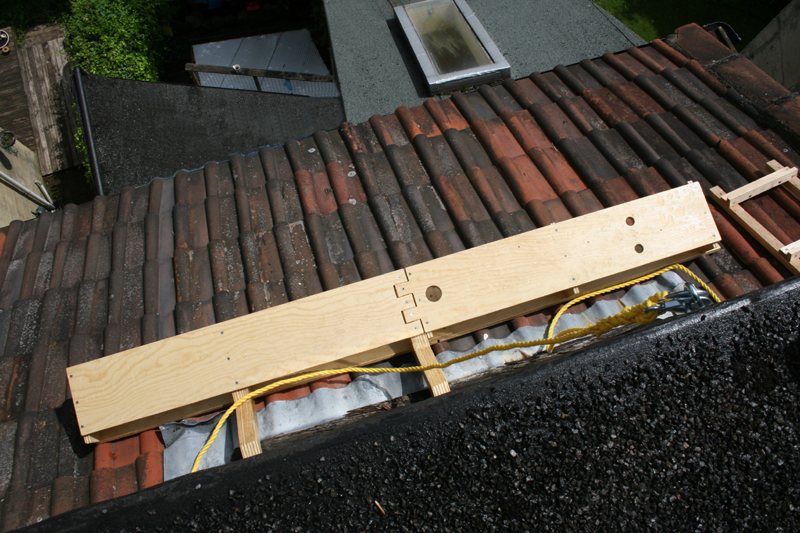
The JKB Window Hookroof platform is a custom built device for hooking onto a dormer window and resting on the roof tiles in order to undertake repairs/maintenance. It saves hundreds of pounds in scaffolding costs and can be stored away in two separate parts after use. Made from stout 18mm exterior grade plywood and sandwiched at the hook in three thicknesses of material, it is screwed and glued together and lacquered with two coats of matt polyurethane varnish and one top coat of yacht varnish. Job done!
The JKB Window Hook platform. Copyright Jeremy Broun 2012
It took longer to design the concept than build it and its hook profile and general angled geometry is made to measure for my particular roof. I had already constructed a roof ladder (see my You Tube WOODOMAIN channel) from a couple of bundles of batten so this is also a very low cost solution for servicing my roof and dormer window. Both sections of the platform are 48" long, conveniently coming out of an eight by four sheet and it makes lifting into position and storage easier.
Looking down on the platform from the dormer window flat roof
There is an extra hitch point where the two holes are to anchor the end of the platform to the dormer roof upright. I used rope but envisage constructing a metal strap that simply hooks into place. The two sections are fixed together in situ with stout stainless steel screws with the larger hole as a viewing hole to locate the screw. Each section is light enough to manoeuvre through the dormer window opening and fix into place on the roof and the hooks amply clear the window sill and flashing if repairs are needed there, which in my case they did.
The platform is made in two sections for ease of mobility and storage
If you are a woodworker/housebuilder who would like to use my idea all I ask for is an acknowledgment or better still buy my Routing DVDs (from WOODOMAIN.com) as a thank you for my ideas. It would cost me too much to patent many of my ideas but I believe in the universal law of what goes around comes around. My device may be featured in a future issue of 'British Woodworking' magazine as an example of resourceful woodworking. I intend doing my own roof repairs for as long as I am active. If you use the idea and make a similar window hook platform I cannot accept any responsibility for its safety, not least because build quality is important. If you are 25 stone heavy obviously the way I have built mine would not be strong enough. Safety always comes first and it is imperative to use an anchored safety harness when working on a roof. .
Probably the most successful British chair of the 20th Century is the polypropylene stacking chair by Robin Day for Hille International. The tooling costs were around £6,000 and it retailed at under £5. I was always inspired as a designer maker by the giants of mass produced innovation and found myself an increasingly reluctant member of an exclusive social club - British Designer Makers from the 1970's onwards. I did work on the shop floor of a furniture factory as a trainee designer in 1973 but found the British mass production furniture industry depressing in the 1970's.
Stacking chair by Robin Day for Hille (1966)
However, another icon of late 20th Century furniture design recently caught my eye in a local 'junk' shop which was a must have for me - four 'Supporto' chairs by Fred Scott, also for Hille International. I only want one for my quirky office but I am having to buy all four and hope to pass the others on. This is the classic original ergonomically designed modern office chair but most in my heritage city would be ignorant of its existence.
'Supporto' chair by Fred Scott for Hille (1979)
It is not the first time I have picked up a scoop locally. A couple of decades ago. I picked up a classic Harry Bertoia chair from my local market for £5 and use that in my home. Who is Harry Bertoia you ask? We know who Simon Colwell and Cheryl Cole are!
Harry Bertoia chair (1957)
But back to the plot - my passion for furniture design is re-kindled when I see a classic modern chair and my home is just too full of chairs so I am having to build a separate sealed storage area for my micro museum! The very first chair I made was actually a copy of 'The Chair' by Hans Wegner and I delighted in spokeshaving the arms which are highly sculptural. I made it out of teak when I was 17 and it was one of my major pieces when I was at Shoreditch College, so I must have made that chair in 1966 and all it needs today is a fresh smearing of Danish oil. The cane seat is still immaculate despite occasional use over the years.
'The chair' by Hans Vegner (1949)
I think it is important to know our history. I visited the Cheltenham Celebration of Craftsmanship exhibition last week and apart from feeling somewhat let down by the chairs on show (the public chair competition), noticed a table by a maker that was an exact copy of a table by a designer maker friend of mine - John Coleman in the 1980's. I actually could not bring myself to mention this to the exhibitor so here I am referring to it on my blog. But surely in this age of 'graduate masters degree' furniture maker they have studied their history, especially the recent history of designer makers? In my Furniture Today DVDs the history is detailed with hundreds of images of furniture design and many colleges stock my DVDs.
Veneered Table by John Coleman
'Maker Designers Today' exhibition at Camden Arts Centre 1984
I am certainly not accusing this maker of blatant copying as the design possesses a certain structural rationale that could be conceived by more than one mind. But in a previous exhibition there was a submission for not just a direct copy of a classic design but the design itself, a stool was used and the top just re-veneered in burn walnut which stuck out like a sore thumb! I alerted the exhibition curator but goodness me I am not a member of the design Police but just surprised by ignorance in this graduate craft culture.
Laminated birch stool by Alvar Aalto (1933)
The wonderful thing about furniture design history is that it may be far from popular culture but it has a lasting and satisfying dimension to it and something to pass on. On my 90th birthday I intend holding a retrospective exhibition of my furniture designs and also show my chair collection which one day will be handed down.
Cantilever chair in elm by Jeremy Broun (1984)
inspired by Marcel Breuer's 'Chair with no legs' (1927)
The designer Ron Arad once said to me 'a chair should have a very good reason for being'*. I would agree with that. It would be arrogant to claim total originality as we all know ideas come from somewhere and I think at least if one is inspired by one design to create another, the source should at least be acknowledged as a respect for that designer. But what does that silly old-fashioned term 'respect ' mean today? * 'The Chair' video 1990 (now on DVD) by Jeremy Broun
Andrew Varah died in July 2012, delivering something of a shock to the British bespoke furniture making community where he had become a distinguished figure; the bloke I recall from my student days, who always sat at the top table, and where after a late start in the furniture making world, he arrived. It was little surprise he was ambitious as he was the son of Chad Varah, the founder of the Samaritans suicide telephone line, member of MENSA and his mother, head of the Mothers Union Europe. Andy was a triplet and identical twin.
I first met Andrew in 1963 as a fellow student at the legendary Shoreditch Teacher Training College in Surrey. In our second year Andrew got me a room in the sought after old college building alongside his close mates Geoff Buckland, John Eustace and Max Carter. I suppose the obvious thing we all had in common was that we spoke without an accent and so it was probably a class thing. I guess in retrospect we were an elite group although I saw ourselves as different rather than better than the main core of trainee handicraft teachers. We tended to be more independent minded. Shoreditch College was a fantastic training not just in woodworking skills but in other craft disciplines such as metalworking, basketmaking, pottery and bookbinding and we had the very best practitioners in the country as tutors. My God those were the days and I shed a tear on the very last day of my training looking over Runnymede from the college campus, thinking it will never be as good as this again. Shoreditch was renowned for supplying not only the best teachers but the pranks that went on at the college were legendary. From one of the towers in our residential building I recall being roped in by an errant third year student to spray one of the college tutors on duty with a fire water hose and later hiding in Andrew's wardrobe while the search party sifted through the study bedrooms. Andrew was sitting in bed wearing a nightcap, reading a book, innocently pointing to the open window which happened to be four storeys up and telling the tutor 'maybe they went that way'. I was nearly kicked out as an example to other students but I went on to gain a Distinction on the Advanced Woodwork course while Andrew became social secretary and was out with the girls rather than pushing his cabinetmaking skills. Andy helped me buy my first Morgan three-wheeler and we drove out to secluded pubs in Virginia Water in it and even attended a party in Surrey held by John Gregson the actor. The three-wheeler had no reverse gear and on one occasion we plunged through somebody's garden fence in Bagshot. We shared many fun experiences lasting into our thirties.
The first 1933 Morgan three-wheeler arrives on the Shoreditch College campus in 1962, causing a sensation amongst students and staff.
I took Andy salmon poaching on wild Scottish rivers (my home was in Scotland) and on our last day of the trip I said 'I can't send you back to London empty handed'. While my older sister stood lookout for the bailiff, I hooked the salmon and Andrew landed it.
I hooked the salmon and Andy landed it
- an apt description of our furniture making careers. (1968)
On a furniture travel scholarship abroad my car was stolen and he offered to drive over to Holland to pick me up. I managed to get an old banger and arrived back from a 24-hour drive straight from Italy to his barn workshops near Rugby and he was the first to see all the exciting items of innovative furniture I had been given.
The old banger loaded with gifts from Artek, Cassina Artemide etc
- first port of call Andrew Varah's pad 1979
At the beginning of our careers Andrew and I taught in tough London schools and met up in our respective school workshops after school hours to brainstorm designs for school projects. We were pioneers of design in schools a decade before Design Craft Technology became officially part of the curriculum. We both left teaching after two years and Andy went to work in Zambia running a furniture factory. He invited me over to be his designer but my phobia for injections stopped that. He returned around 1974 but in preceding years had written to me many times asking what it was like to be a 'designer maker' and saying he wanted to do what I was doing back in England. He set up as a solo maker and so our contact was much closer. I visited him many times at Little Walton, mucking into the renovations of his barn workshop. He had a fantastic pad while I was working in a tiny underground city workshop without natural light. A strange contrast as at the time he was an unknown and I was well acknowledged in the field by galleries and magazines. Around 1979 I introduced him to the Prestcote Gallery and remember his very first exhibit there, an inlaid table in ash. It was a electric time as the new boys exhibited alongside the old boys; A Fred Baier chair sitting next to an Edward Barnsley table.
An ash table by Andrew Varah circa 1976
Perhaps ashamed of my own somewhat modest workshop I turned down an opportunity in 1989 to be filmed for a regional television craft documentary and introduced the film director Trevor Hill to Andrew Varah who at that time had just taken on the genius woodworker Andrew Whately from John Makepeace's workshop. I think it was Andrew's first television exposure and at that time a rare insight into the work of furniture designer makers. Jan Leeming, ex News reader was the presenter.
A chair by Andrew Varah around the time of the first television feature
Andrew delighted in pleasing his clients and working to their needs, often adding whims drawn from different architectural periods making his actual designs somewhat derivative and overplayed in clever craftsmanship in my opinion. I felt he became a bit of an 'untouchable' in terms of design critique but then there are no critics of bespoke modern furniture! If it were a West End play the performances would be torn apart by ruthless critics (Kiera Knightly playing Anna Karenina)! But design apart, Andrew Varah became a formidable maker and guiding light to a new blossoming generation of furniture designer makers. It was the late Alan Peters (who also trained at Shoreditch College) who said in 1974 this is surely the most difficult craft to sustain. I still have some prime quality flitch cut English oak Andrew sold me at cost price in the year of the drought in 1976 and some Rio rosewood veneer he gave me on the same occasion. In our halcyon days Andy would often get to meet the girls I dated and would say 'I can't believe how you can pull the most beautiful birds' yet he could pull the most prestigious clients and was really in a different league running a furniture business and employing talented young craftsmen, many of whom stayed for decades. There was obviously rivalry between Andrew nyself. Even as students he once told me he could run as fast without training as his identical twin brother Mike who was running 800 yards for Britain. I told him he was arrogant and challenged him to run around the college track. He beat me after 26 laps and I was in the college athletics team and he wasn't! Curiously as my furniture 'career' suffered because of depression in my life I once admitted to Andy I had often phoned up his old man's outfit the Samaritans. I got the impression Andy did not get to see much of his father in his youth. Despite our more recent fall outs, we exchanged an amicable conversation at our last chance meeting at an exhibition in Cheltenham where we were both judges for different awards. I made a film including him called 'Five Ways to Fashion Wood' in 1989 and a light-hearted clip called 'Three wise men' in 2005:
Inevitably Andy and I followed different paths, but nothing can take away our early formative and fun years. Varah RIP.
Many years ago a well known award winning local architect was tragically killed whilst chainsawing a tree on his land. It fell on top of him and one immediately thought how could this happen to such an intelligent well organised person but it also served as a reminder of the yin and yang of life, that wood is a provider but one could also potentially die from a splinter.
For much of my life I was blessed with a wonderful gift of confidence to do anything with wood, I had no fears and nearly twenty years ago when totally re designing and re building the roof of my home I also built timber scaffolding out of two by two which I left up for nearly a decade on the back of my house!
In a previous blog I described my near escape from death last November when I clambered onto the roof to do some repairs and found I did not have the strength to pull myself up onto the dormer window roof. Well I found the strength hence I am here to write this but am now faced with the same challenge of sorting the roof out and building a stable platform. The problem is I am terrified of setting foot on the 45 degree roof pitch quite apart from avoiding looking down four storeys. I used to be a rock climber at school and followed the A team up the Derbyshire gritstone Black Rocks in just gym shoes and no ropes. I never experienced this fear before and although I am sketching out designs for a timber scaffolding structure to hook over the ridge I have the fear for the first time in my life that wood will fail me, that however I construct the scaffolding the fibres might tear, the screws might sheer etcetera etcetera.
Fear is a dangerous thing! So I am provaricating/procastinating and making extremely slow progress and fearing the very thing that has given me joy and confidence since I was sixteen - wood. So as you go through life, not knowing why you are here or how long you will be here for and stepping outside the social conditioning of leaving the nest and creating your own little nest and following the conveyor belt of life, drinking beer and following football teams on the way what else is there?!
Some might stop to ponder at how life seems to deal out certain cards at different times and that some of those cards maybe interpreted as lessons. Is it merely a game of Monopoly at the rolling of dice? 'Go to gaol', 'collect a wife' or 'collect diabetes as you pass'? Of course one of the lessons taught is you can't take it with you but obviously not a lesson learned as money is seemingly even more of a God today. The late Paul Getty, richest oilman on the planet in the 70's (whose art foundation once purchased one of my furniture designs) had a deep fear of poverty and brought himself up from the gutter, so fear can be a great motivator as well as energy seeper. Certainly thinking too much can be a serious damper.
On my observations even the most clever people appear to think very little about major life events in the sense of cause and effect and just as the 'nature versus nurture' argument persists I also wonder if being master of your destiny or victim of fate is a similar puzzle? Certainly no one I know is in control of their lives but it keeps you sane to think you are. Now, lets get over this silly fear of wood and start thinking positive again. In fact, better than that - get back to the doing.
Many will know the colour and style of Cheryl Cole's hair, few will know who Cheryl Cole is and everybody knows who Simon Cowell is. Few will know that in 1934 Gordon Russell made Murphy radios and few will know who Gordon Russell was.
It was on BBC 4's Today programme that I woke up today to the words 'Gordon Russell was one of the greatest designers of the Twentieth Century'. Not only one of the greatest designers, I have chosen to refer to Sir Gordon Russell as 'The Father of 20th Century British Furniture Design' in my film documentary 'Furniture today 3' (available at www.furnituretodayuk.com).
Gordon Russell was a hugely important figure having been involved with The Festival of Britain, The Design Council and Utility Furniture. It is perhaps Utility Furniture that strikes the main chord with me; functional simple furniture designs born out of necessity when there were material shortages during the Second World War and made in modest workshops around the country. A lesson indeed for furniture students to toughen up and design to a disciplined brief but above all making furniture accessible.
Gordon Russell although inspired by the Arts & Crafts and in particular the understated forms of Ernest Gimson, differed with that movement in his total acceptance of the machine embracing it with hand skill. Such snobbery or indeed ignorance still exists today not least in the minds of a small section of the public who expect a crafted object to be totally made by hand. Even in the sweat shops of India and China the machine is fast replacing handskill. Curiously, William Morris a pioneer of the English Arts & Crafts movement cried 'Let us be masters of machines not their slaves', but his work was predominantly taken up by the Bloomsbury Set and still assumes a whiff of exclusivity today.
The BBC Radio Four design competition for amateurs to design a radio sounds a great inititiative. Let's hope some innovative wooden radios will persuade the judges. For many years I have listened to a Roberts radio in my workshop, a plywood chassis housed in solid Teak. Today Roberts Radio fill the shelves of Currys stores shining in their glossy plastic. Arguably modern technology transcends the superiority of wood as a sound baffle although I still have some massive "Class A" KEF speakers I built in 1970 using chipboard.
One of the features of Gordon Russell Utility furniture was the use of thin plywood for door panels. Plywood for much of my furniture making career was looked down upon. A local furniture shop declined my plywood rocking chairs saying 'the public don't like plywood'. Russell, of course, was building airplanes for the War Effort and plywood was clearly a superior material then. Unlike Murphy's Law, Murphy radios seldom went wrong!
A Murphy radio built at the Gordon Russell factory in Broadway in1934
Veneered plywood would have been used in the construction.