Here is one of my latest pieces which may well be submitted for auction at Sotheby's:
'Freestanding Storage for the Emperor's New Clothes':
The piece expresses the interaction between man and nature - the
interference of man with nature (by compromising natural wood by
turning it into plywood) and Nature's revenge by letting loose the
force of its elements - rain, extreme sunshine etc. In its previous
life the Objet d'art was a Ulitlity style oak veneered single
wardrobe, perhaps designed by Gordon Russell and made in one of many
sweatshops around the UK after the Second World War. The veneers
have separated, peeled and curled, exquisitely revealing the stark
bland core material. The cast metal knob remains intact and firmly screwed to
the decaying plywood but seems to be saying 'am I next?'. The stain
varnish is blistering in its pretence of being something it isn't.
This masterpiece emerged by accident as I removed an otherwise
ordinary, functional and lack lustre piece of furniture from service
and left it outdoors to be taken away. The wardrobe door still opens and closes, the piece is
still standing and I believe it is both a valuable expression of our
rich furniture history and the direction our craft could take.
I think it demonstrates
where I am with my craft currently, the options that are open to me
having proven I can make anything in wood to the same technical
standard as a robot on the day the grid crashed. The piece takes
furniture forward from utilitarian, to visual, to stark reality
functionalism - the ravages and revenge of nature on a humble piece
of utility furniture.
I am just in the process of writing another e-book and this one is called 'The Woodworker's Cave'. It evolved from a chapter in my 1991 book 'Electric Woodwork' called 'The Electric Workshop'. This book focuses on small workshops exploring priority tools and machines, limited space and budgets.
In my research in updating to the current era but also dipping into the past I recalled those wonderful little combination woodworking machines in the early 1970's by a French company called Lurem and an American company that launched the famous Emco Star woodworking combination machine. Albeit aimed at the DIY market, these machines were at the vanguard of the power tool revolution and I wonder why there are not similar machines on the market today that offer the functions of sawing, planing, drilling and routing for the small solo workshop where space is limited.
The Emco Star combination woodworking machine - 6 functions
A fabulous lathe attachment adds to the bandsaw, circular saw, disc and linisher. Wow, what a package! Bring it back!
The Emco Star 2000
Well I tracked an old Emco star down on Ebay and bid for it and won it and consider I got it at a very reasonable price considering its huge potential in a tiny workshop such as mine! Here it is:
For me a priority tool is a bandsaw, however small. I do of course have a massive bandsaw in my main workshop but this feature on the Emco Star is worth its weight in gold (or should I say green Hammerite paint that I am going to change). The other really useful features are the circular saw, sanders and horizontal drill bed which can be used as a router. Dust extraction needs attaching of course and no end of custom/extension jigs can be added. There modern combination machines are much bigger, slower to chasnfe mode and probably require a concrete floor whereas for small scale work the Emco Star is a winner. Why isn't it made today?!
One of the very few small machines available today seems to be the Spanish Stayer Combi 160. This is a circular saw, planer, thicknesser and milling machine all in one.
Stayer Combi 160
Minimax C30
Slightly larger and more suitable for the professional workshop is the Minimax C30 is a circular saw, planer and thicknesser, and spindle moulder at a tidy price of just over £4,000.
Of course the trade off with these combination woodworking machines is a huge space saving advantage against the chore of changing modes and setting up for different functions. Some of the modern machines of course have separate motors.
I must admit I wouldn't mind getting my hands on an early Emco star. It looks a lot of fun but then my workshop is already crammed full of machines that I would not have the space. A section in my new e-book will probably be on living room woodworking centred around a very efficient quiet running chippings extractor!
One of my must-do-before-I-leave-the-planet projects is to do up a small van and take guitar, dog and woodworking tools travelling - picking up work on the way. I can visualise that little Emco Star in a compact trailer. At the time (1973 to be precise) I looked down my nose at that machine and invested in the more robust looking and larger capacity Coronet Major instead. But today
My new e-book will be viewable online, downloadable, printable and including videos.
Anyone thinking a motorcycle aimed at 20 year olds isn't going to appeal to geezers (geysers) like me, overlooks the fact that some boys never grow up (or grow old). It was back in 1986 I last owned a 400cc sports motorcycle - a Suzuki GSXR-400 that I bought new in that year. Ever since parting with it in the mid nineties I have been waiting for a state of the art 400cc cafe racer bike to appear, so when it did suddenly appear in the UK a week or so ago in the form of the KTM RC390, I leapt at it and bought it from the Bristol showroom without even riding it. Well, I wasn't given much choice as KTM do not have a demo bike.
2014 KTM RC390 - one of the first in the UK
my 1986 limited edition Suzuki GSXR-400
The rave reviews on YouTube and in the motorcycle media made the decision to buy the KTM road racer easy and I haven't had as much excitement waiting for the machine to be prepared as when I was sixteen and owned my very first motorcycle. That was a 1944 James 125cc bike with hand gears and a top speed of about 40mph. I rode that bike from Wiltshire to my uncle's home near Loch Lomond, north of Glasgow, in the famous winter of 1962 and I literally froze on the way up - my legs had to be thawed out at a petrol station as my bike fell over on top of me into the deep snow when I tried to put my feet down.
My first bike - a 1944 James 125cc motorcycle with hand gears
So anybody claiming this new KTM road racer is uncomfortable or hard on the bum or wrists is a wimp in my book. Go buy a Harley or a BMW with heated handlebars, stereo and GSM to tell you where the tarmac is. Just don't even consider a bike that is clearly designed for the track! I don't even know what ABS is (which apparantly the RC390 has). I thought it stood for Acrynitrile Butadienne Styrene which in plain language is a common plastic! And plastic there is plenty of in the RC390 as the composite petrol tank cover won't take my magnetic tank bag! But when you buy for sheer looks you expect to make some compromises, but I reckon this bike will be so successful it won't be long before an aftermarket stylish tank bag appears. Okay so the stunning looks of this half-Italian-and-half-Japanese-looking Austrian-bike-made-in-India grabbed me and I soon found it ticked the boxes concerning performance and economy. The bike can do over 105mph and return a fuel economy of 70mpg if ridden sensibly. Well sensibly to me is having a lot of fun on A roads at around 60mph and then using the power to overtake quickly. As I'm running the bike in and as I write have only clocked up 200 miles I am keeping the revs below 7,000 which takes me to a cruising speed of over 60mph. I haven't tested the power band yet but it promises to be really good for a single and I suspect KTM know their singles well. Certainly this one is hot running as the fan cuts in rather unexpectedly in low speed traffic so I would imagine the engine is running at full efficiency. Its not a new engine but similar to the established Duke 390 street bike.
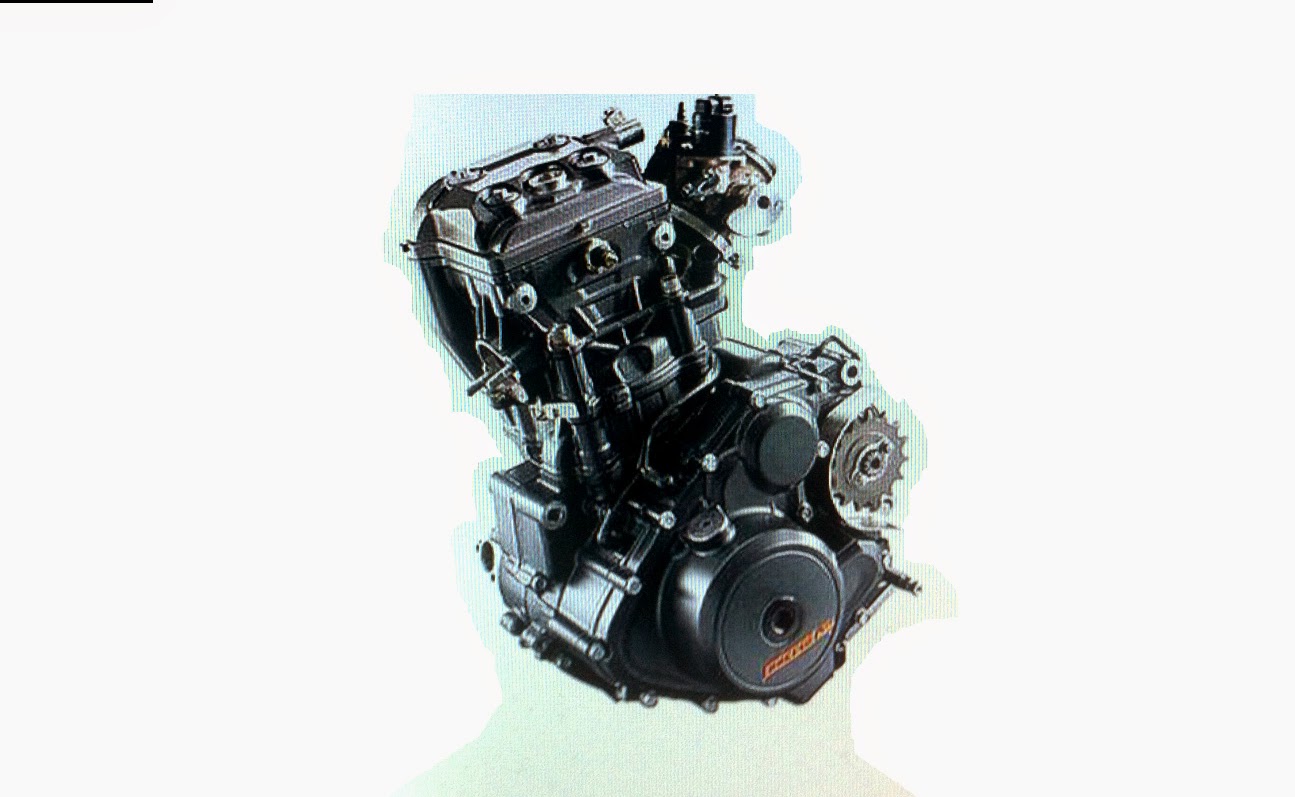
373cc single cylinder engine. 12.6:1 compression ratio. 44bhp
Well here is my initial YouTube review going on very first impressions as I drove it the first twenty miles:
My first ride YouTube video
Isn't it funny how after the very first few "honeymoon" rides you begin to notice things that you thought you had already looked for and hear sounds that maybe were there all along! It drizzled the morning I filmed the bike so I cleaned it and wiped it down with a soft cloth only to discover minor scratches on the digital dash a few days later. The sun catches the scratches on what I expected to be a glass but what is a plastic instrument cover. Okay I can live wit that but one thing I don't know is how durable these KTMs are. The build quality seems really good on close inspection and I am told that the bikes are quality checked by KTM guys in the Indian Bajaj factory. But do they last?
The digital dashboard of the KTM RC390 I'm still trying to figure out how to configure it
The bike is fantastic to ride and is so agile that you almost want to drop it right down on a corner even when running it in at low speed! I do notice (not just with this bike) how I have to lift my right foot onto the brake pedal rather than just pivot my boot on the footrest. Is it just me? I'm five foot ten and interestingly fairly short riders will struggle with this bike as in the showroom a girl of about five four couldn't reach the floor. My mate's girlfriend is five foot six and when we went on a trip with two bikes yesterday and she sat astride my bike she could just touch down with both feet on the tarmac. I told her high heels aren't ideal and I always leave mine at home.
There are one or two really nice touches to this bike - the short side exhaust which I first saw on a Suzuki GSXR-600 a few years ago - I just love it. The front headlight design is like looking in your rear mirror and catching a glimpse of Alien. The fairing is minimal and purposeful. There is no spare fat on this bike and I read somewhere else that the airflow is excellent at high speed.
The wing mirrors are just about my only grip because they relate to safety
It really is 'form follows function' with this bike and this is echoed in the narrow section mirror arms except the mirrors don't work very well - your forearms are in the way. After 200 miles I have now learned how to flex my arms so I can see behind by looking under my arms and then quickly tucking my arms in to check the blindspot - but then who is going to overtake you? Just a much bigger bike! This bike will probably take on a lot of six hundreds.
The KTM RC390 race version with Akrapovic exhaust and race seat
KTM use the same frame for a 125 and 200cc version of this bike. The rear tyre is a chunky 150mm wide giving it a big bike look. Well, its a small bike really that looks bigger.
11 October 2014 - one of the first bikes in the UK
I almost forgot; the KTM RC390 comes out of the box with a pair of superior grip Metzeler tyres. Unlike buying a new guitar you usually have to bin the strings supplied and buy a decent set. I normally get a good two thousand miles out of my tyres so it will be interesting to see how long these sticky tyres last once the bike is run in. I feel a very lucky guy to be an early adopter of this exciting new bike and I'm not joking when I say it makes me feel like I am sixteen again! I watched a TV documentary about Guy martin helping re-build a Spitfire that he got to fly. What a great and engaging guy he is - I would love to know what he thinks of this little bike! Well, please look out for my second more in-depth review when the bike is fully run in and I can test that power band and get a better feel of the economy. Suffice to say, after a 60 mile country ride yesterday, the bike was fantastic, a little wrist ache that practice will deal with and great for stopping to stretch legs every twenty miles - after all you have to pull into a layby frequently to get off and admire the look of this bike. I reckon Wiltshire to Scotland no problem for me - but summer only! Sorry to those woodworkers who expected me to be reviewing secret mitred dovetails! All dovetails makes Jack a dull boy. Well, okay which of my furniture designs can I dig up to relate this road racing motorcycle to? Probably my Kangaroo rocker:
The Kangaroo Rocker designed by Jeremy Broun in 2010
This chair is minimal in structure with no spare fat, relying on four main components and made largely with the router. Its made of ash (so treasure this wood as it is currently hit by a species threatening disease) and the main joints are massive halving joints, familiar in carpentry but unusual in chair making. Like the KTM RC390 it is great on the bends especially for not-so-young rockers like me. But unlike the Austrian KTM made in india it is designed and made in Britain and by one mind and a pair of hands.
One of the first lessons a young man learns when dating women is to avoid the YES/NO question at a dance! It gives the girl the prerogative to say no and if you want to date her and you are not the best looking guy on the dance floor you have to try a different approach! I don't know what was in Cameron's mind! I normally keep this blog to woodworking matters but on the eve of a historic and highly divisive event I make an exception! As a proud Scotsman (by blood) with family roots north of Glasgow (where I lived) where my grandfather on my mother's side was a landowner and my other grandfather was a churchman in Edinburgh (he worked helping in the slums), I have no vote, nor do the rest of the UK over the destiny of the entire UK. So, if I can influence just one vote I will have done my best.
Images courtesy my friend Tim
I made a video (below) about my home roots at Carbeth estate where my grandfather used his privilege to set up around 200 huts in the 1920's for Glaswegian workers to enjoy the countryside. My uncle (my guardian) followed the tradition but the Carbeth Huts became a class war issue hitting the national headlines under the ownership of my cousin in recent years whereby the rent was put up from just over £10 per week to just under £13 per week (the first rent rise for a long time). Huts were burned down by some of those refusing to pay rent, air guns were fired and a dog killed and there was an orchestrated hate campaign against those who paid their rent and against my cousin who was regarded as 'the toff living in the big house'.
http://youtu.be/ICQ1oW11adw
There are lots of 'toffs' living in big houses in England behind electric gates and who do NOT allow their land to be used by less advantaged people at a low rent. Before you immediately think I have scored an own goal, I accept a serious question in a modern democracy is whether inheritance is fair (it is taxed) and this challenges the very Monarchy that Alex Salmond welcomes as the head of the new Scotland (if he is to be believed). Land ownership is only the visible face of perceived elitism. There are much more. So here lies all sorts of ambiguities to the complexity of modern Britain! However, I believe there are points here that suggest the Carbeth issue is in a way a microcosm of what is happening in Scotland: Alex Salmond states he will refuse to pay the Scottish share of the national debt (akin to Carbeth hutters not paying rent), and uses bullying and intimidation in his campaign (e.g. intimidation of the principal of St Andrews University to support Independence and some business leaders). Many people believed the Carbeth land belonged to them and the issue was deeply rooted in the Highland Clearances. The other significant point is that after painful negotiations the Carbeth Hutters dispute has been resolved in as much as the land ownership has been amicably transferred to the hutters (as my film shows) and is a first for Scotland, so, much change has already evolved from what I recall as a Feudal society. Interestingly The House of Lords is based on privilege and whilst some wish to abolish it, in theory it is independent and many of its proponents have instigated huge social reform or justice for minorities such as Lord Longford on prison reform.
But does this Feudalism still exist in Scotland? Salmond has constantly referred to the 'Westminster elite' (and that banks and supermarkets are puppets of the government) and claims the Scots are still 'underdogs'. I would suggest a very real issue is one of geography: the very northern tip of Scotland is 300 miles from Edinburgh, Cornwall is around the same distance from Westminster. Some Shetlanders who want independence from Edinburgh, claim the fishing industry will keep them going in the way that Salmond claims oil will fuel Scotland's overall independence. Well, other nations poach fish and there are no guarantees there will be a high price on a barrel of oil with alternative energy technologies fast emerging.
An oil rig in the north of Scotland
Separatism will badly weaken defence which will affect every corner and whether you believe in Trident or not and irrespective of cost, the world out there does not just belong to sandal wearing pacifists as history tends to repeat itself! It is an unresolvable human characteristic since the bow and arrow. National boundaries are not 'invisible' as Salmond claims when economic differences between nation states inevitably emerge such as higher food cost in Scotland and a separate defence system. Vulnerabilty on the internet can happen very fast. The argument that he is being 'perfectly reasonable' to allow Trident five years to be dismantled is disingenuous. Is the option that a tug turns up and simply tows it away overnight! Alex Salmond has demonstrated he is the supreme champion of divide and rule (right down the middle fifty fifty!), but don't be fooled that the Scots will rule themselves as the world is more complex today. There is the question of currency, membership of the EU and the small matter of just how bloody minded the English government might be after the referendum! There are just no guarantees. What special right has this ambitious politician with his highly efficient tightly nit small team got to break up historic and current bonds and friendships between the Scots and other's in the UK, not to mention creating divides in just about every Scottish community?
Hadrian's Wall - keeping the Scots out!
There has been much talk about a fairer society in Scotland and yet Scotland under Salmond has negotiated successfully more and more for what it wants from Westminster. Poverty is not just a Scottish issue. In my own southern English wealthy city of Bath there are currently food banks. We already have polarity in our society. Why encourage more? The debate has been largely parochial, but a fantastic debate and as a scotsman myself with a loving bond with my mother country I would want the best of equality of opportunity there. Glasgow is far more vibrant creatively than where I live, the Scots identity is very strong in the media and the achievements for innovation are legendary. But this will be an uncomfortable divorce and Salmond has been dangerously clever at appealing to emotion and using manipulative Braveheart language over huge uncertainties and assumptions that on Thursday everything will fall into place for Scotland. The English have been caught napping but then they have no say! They probably thought it would never happen. Salmond has won either way. Britain can never be the same again. The deal on the table offers far more to Scotland either way and even a revolt in Westminster now! What a disgraceful mess politics is on all sides when broken promises are default mode! Fairness is a touchy issue and a can of worms! But I can see the excitement about a perceived better future by Scots feeling negated by Westminster but his is the whole north/south issue. The English do have a lot to learn from the Scots and not least the sense of community that is lacking in England and the warmth and friendliness is endearing, but we are a unique multi national partnership and the outcome of this is a huge risk. As an innovator myself and thankful for my Scottish DNA, taking risk is the basis of trying out new ideas. In my field as a furniture designer I see Britain as a conservative backward looking nation generally and the Scots are very likely to take a risk in a few hours from my writing this. But in tossing a coin (because this is what it has amounted to) do I'm going to stick my wee Scottish neck out and say the vote will be 'no' and that the cards on the table has to be more change for Scotland! Nothing is forever; another referendum another day, an appeal? Etc Etc. A unique quality of Britain is we work well together and we look after each other. We have just got to work a bit harder at it. Thanks for reading. No hate mail please! Ps. Remember that guy in Glasgow who watched his kettle boil one day and therein started the Industrial Revolution, or was it some other guy in a tin mine in Devon? Come on, lets all sit doon aroond the table and have a wee cuppa tea!
Imagine you want to make a plastic gnome or plastic whistle, no, lets start again; imagine you want to make a replacement part for a tool or machine, perhaps a threaded bolt, large flexible washer or toothed belt drive that you can no longer get or takes weeks to arrive in the post, or just want to have some fun making a coffee cup with two handles for your loved one. With 3D printing you can create virtually anything in the known universe in an increasing variety of materials from thermoplastic ABS or bio-degradable PLA to imitation wood, resin, and even titanium or chocolate! All at a cost of course as you can spend a million pounds on a printer or as little as £300 for a DIY kit that rests on your desktop. I'm intrigued, confused and impatient as it all seems to be happening now as PC World and Maplins announce their first consumer products which by default have to be 'point and squirt'.
Maplins Velleman K2800 3D printer kit for £690 takes three days to assemble but at least you will know how it works.
Basically there are several technologies in 'rapid prototyping' or 'additive manufacture' ranging from layered heated filaments (a kind of robotic hotmelt gluegun) to laser resin and powder forming. I am focusing mainly on the cheapest technology here called FDM (filament deposition manufacturing) found in printers up to about £2,500. They do of course all use computer software and the two elements are the initial design software such as 'Ketchup' and the delivery-to-printer software such as 'Cura', '123D Make', 'Cubify Sculpt' etc. Some printers print remotely from a memory card.
Now, obviously I've never used CAD in all my years as a furniture designer maker (as I refer to 'Ketchup') but my 3D roots do stretch back to grammar school when I was in class 3D, a reflection perhaps that creativity and academia were (are?) on a different axis! So, this blog really is a total beginners' guide with an attempt to bring together a lot of snippets of information I have picked up and I think my use of the word 'Ketchup' is apt in the importance of attention to detail when making a purchasing choice.
The burning questions for me are quality, ease of use, variety of print materials, running costs (consumables and energy consumption), reliability and support. The initial cost of machine is secondary as it will pay for itself if these fundamental boxes are ticked. This is where the forums are a very good place to go if you can get a handle on the technical jargon used and of course You Tube helps enormously so my choice of videos here is carefully considered and they are of course mostly brief. But I wish they would use a macro lens on the camcorder!
I'm going to condense a lot of ideas and snippets of information racing around my head as a result of some prolonged internet research. Needless to say I am still having difficulty actually getting my hands on a 3D printed sample and neither Maplins nor PC World carry printers in stock!!
We are told the 'Makerbot Replicator 2' is the market leader but is not Open Source which confuses me as it has free shared download designs from a site called Thingiverse. 'Ultimaker 2' (recently released) is Open Source (accessible shared free online design files) and achieves 20 microns accuracy as opposed to the R2's 100 microns (still very good) so these are possibly two of the top contenders. The PC World 'Cubify' achieves passable print resolution at .2mm (200 microns) and does not have a heated bed which is needed for the stronger ABS which in any case is only 30% as strong as injection moulded ABS. The 'Formlabs 1' printer uses a stereolithography resin laser process and achieves 16 microns which is best resolution under £2.5k but you have to dip each component in a cleaning solution and as far as I can see it cannot create rubberised objects that the Ultimaker 2 does. However, I expect that will all change. But it looks a bit laboratory like to me and the resin isn't cheap.
Formlabs stereolithography resin printer for around £2,000
claims the best print resolution at 16 microns
A recent 'Kickstarter' funding legal battle might cause a bit of caution although I have read somewhere it is a tactic used by Apple to kill off competition even if they lose.
Elsewhere on the internet the current 'Top ten reviews' is a bit like 'What's the question but whose asking' as deeper research does not always deem these reviews reliable or meet your particular needs. http://3d-printers.toptenreviews.com/. Interestingly in his 2013 3D printer Guide (http://www.tomsguide.com/us/3d-printer-buyers-guide,news-17651.html) Tom likens the assembly of some 3D printers to putting up IKEA bookshelves - yeah, for some that task takes all of three days! The review is a good read about 3D printing technology.
So what have I got to add? Well, the deeper I get into this my priorities are quality, ease of print and versatility of materials that can be used. Speed is a consideration because even if you go off and do something else, if you print ABS it has a smell that will linger for hours. A chess piece as demonstrated in the PC World 'Cubify' printer can take about half an hour. Quietness also counts if you don't want to be driven insane by Darlek sounding noises throughout the night. In this respect the 'Ultimaker 2' operates at under 49 decibels. Size of printed object varies from a coffee cup (typically the Cubify) to a basketball (UM2) and I'm happy with that as I have no plans just yet to print out my next house which of course is already achievable.
The Cubify at around £1,100 is a basic point and squirt 3D printer using PLA filament
and able to create small objects, but not to any great detail. The filament is not cheap.
Ultimaker 2, a significant improvement on the original and boasting best print definition,
speed and reliability from the small Dutch company
Here are two videos, slightly longer, that caught my attention as being really interesting. One shows a simple USB and memory stick holder made from an open source design which allows you to tweak it and the other shows flexible belts being produced that have impressive detail and strength. Both use the 'Ultimaker' printer:
Thumb drive holder using rigid PLA filament on the 'Ultimaker'
from a 'Thingiverse' customisable design
Flexible filament used on the 'Ultimaker Original'
(3D printer kit) for creating toothed belts.
The Makerbot Felix 2 is a new printer that boasts impressive accuracy at 50 microns and at (http://www.youtube.com/watch?v=DMz6KzacVQo)can handlea flexible 1.75mm filament called 'Arnitel Flexible Rubber' and this printer has really taken my fancy as it combines accuracy with a modest price.
Now, of all the confusing aspects of 3D printing the '1.75mm versus 3mm' filament debate is the most time consuming. All I can do is pass on what is my observation of the current consensus. 1.75mm diameter filament appears to have the edge by requiring less extrusion force, offering more immediate flow, quicker cooling, lighter nozzle head hence faster speed, but costs more! My guess is that shopping around (eg Amazon) and buying in the right quantities filament costs will come down.
I was all sold on the Ultimaker 2 but am still awaiting replies from emails about delivery not that Makerbot are much better but at least as I write, I received an automatic email stating I should hear within a few days. Nobody seems to use the dog and bone (telephone) any more these day, so it is all a bit of a gamble.
Makerbot Replicator 2X optimised for ABS uses Thingiverse
and offers up to 100 micron resolution at £2595
Before I wrap all this up, on the subject of finishthere is a method, somewhat dubious, called acetone vapour smoothing which at least is worth taking a look at:
Acetone vapour smoothing on ABS which is a petro-chemical based plastic
Well, apart from the health and fire risks of this method I would be inclined to avoid the extra equipment and time involved in this rather hit or miss smoothing process and invest in the best quality resolution printer. It seems there is already a lot of hit and miss in the technology, a lot of tweaking, such as getting the print bed perfectly aligned with the nozzle, getting speed and temperature settings just right for the model, creating support structures which different softwares go for.
In conclusion, I started out really liking the Ultimaker 2 but the Makerbot Felix 2 also looks promising to me, trading off not quite the print quality but a more confidence boosting service (currently?) for a minimal looking machine (that always grabs my eye). And the bonus of the 'awesome' Makerbot Digitiser scanner, ideal for someone like me before I learn how to use Ketchup. One small observation is that the shorter feedin tube on the Felix for the filament looks as though it won't cause as much friction as some of the other models when using a rubberised filament. I can't see a built- in digital controller, so there will always be plenty of questions and some of the answers only clear after you have taken it your printer out of the box.
Makerbot Felix version 2 which deliver up to 50 microns in 1.75mm filament at £1440
And what did I say about printing plastic gnomes:
The Makerbot Digitizer Scanner available from Reprap Central for £1295
Some further reference material below but in the meantime don't take any of my ramblings as gospel as the technology will all have changed by tomorrow.
Well, before you laugh at a guy who drives a Smart car that is less than three metres long, consider it is the only vehicle that will fit on my congested road outside my house and fills the gap other cars can't get into! What is impressive about the car is its deceptively large interior and with the seat folded down I took my digital touchscreen jukebox over to Ireland in 2005 for a major exhibition there.
Digital Touchscreen Jukebox that won The Professional Woodworker of the Year Award 2005
Being good at woodwork, despite being labelled a dunce at school turns out to be a wonderful transferrable skill and a fantastic recent tonic for me has been to get away from the rich bespoke and increasingly precious hand-made furniture market that I can no longer relate to (my order book confirms this!) and use the same range of skills and experience to make a boat, well a micro catamaran that fits into the back of my Smart car. Suddenly the isolation of working alone in a cramped workshop transforms into a sociable interaction allowing friends and passers by to try out the boat on my local canal.
I had observed at the beginning and zenith of my furniture design career that innovation was welcomed and innovation is what I did and was known for - new solutions to old problems, new structures, new forms and new functions. But at recent furniture exhibitions where I showed chairs that were uniquely constructed combining a sculptural form, my work went by totally un-noticed and one of life's big lessons is dealing with a degree of 'celebrity' status in your field that suddenly disappears and you become a nobody! The very people who elevate you - the crafts media, choose to forget you and I'm thinking well I'm not finished yet by a long chalk. Admittedly a long illness around 2002 lasting several years robbed my energy and put me out in the wilderness whilst new kids on the block inevitably stole the limelight. One should not complain as 'every dog has its day' but I got a sense that innovation is a tired buzzword and does not really count, but expense and status does and so the field I once helped pioneer in the 70's became an alien wilderness for me in the second decade of the new century.
The Brickrock chair in ash using a technique not familiar in chair design - 2010
Messing about on the river and especially the river Avon near Chippenham and Bradford on Avon was a chunk of my childhood when I built a canoe that was fluorescent yellow and grey PVC covered in white trimmed spruce. My aim has been to float a craft of similar colour scheme down the same river and re visit my youth, gliding past moorhens, swans and over schools of minoes and perch.
Brilliant woodwork teacher Howard Orme helps Jeremy Broun make a canoe in 1961
All my innovative technical and visual skills have been employed in this project and a quiet confirmation to myself that I am different to those guys who pursue absolute perfection in fine hand-made furniture using micrometers and magnifying glasses and can't do anything else, when yes I can do all that but the fun is to build a boat using an epoxy resin glue filled with colloidal silica and have 3mm gaps between the joints that the resin fills. I once worked on a boat that I think was the flagship for the 1986 America's cup in Sydney - a replica wooden schooner and we used epoxy resin with 6mmm gaps filled by the glue. The guys had never built a boat before!
The 'Ena' - Sydney 1986
That's normal in boatbuilding and I'm beginning to become more comfortable with 'normal' which is also more sociable than all those prestigious major exhibitions in the 70's, 80's and 90's showing my furniture alongside the Royal College of Art gang, and they hardly ever said hello to me! The reader will note a twinge of angst, but the truth is complacency never fuels creativity, indeed as Glenn Close once said 'Great art comes from a sense of outrage'. Father thought I was a dunce and banned me from using his workshop as a boy so over his dead body (he died when I was 17) I said 'I'll show you'. You have to believe in yourself ultimately and not listen to those who unwittingly infer 'you can't do it'. I remember those days when to be good with your hands was a serious impairment - an indication there was nothing upstairs! Today the landscape is very different amongst successful conventional professionals who take up furniture making for a career.
But what about the kids of today, who like me, enjoy messing about on the river? Will they have the opportunity and skill base to make a canoe? If my work inspires just a few as indeed I was inspired by a brilliant woodwork teacher at Abbotsholme school (Howard Orme) who helped me build my first canoe, then what I do holds some chance of continuity. Here is my micro catamaran made from just 2mm aircraft plywood and standard softwood battening.
The micro catamaran designed and made by Jeremy Broun -July 2013